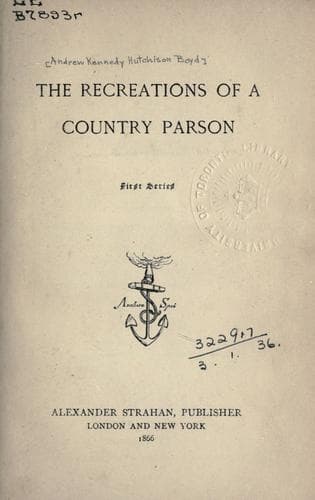
The Recreations of a Country ParsonBoyd, Andrew Kennedy Hutchison
General
The Recreations of a Country Parson
Boyd, Andrew Kennedy Hutchison
Clergy -- Anecdotes; Country life -- England; Rural clergy -- England
Now, we think of nature as existing in a certain way which we
call physical. We call the world the physical world. This mode of
existence involves inertness. That which is physical does not act,
except passively, as it is acted upon. Inertness is inaction. That
which is inert, therefore, differs from that which is not inert by
defect. The inert wants something of being active.
Next, we have a conception of another mode of being besides
the inert. We conceive of being which possesses a spontaneous and
primary activity. This kind of being is called spiritual. This
kind of being has shaken off the reproach of inertness. It can act,
and originate action. The physical thus differs from the spiritual
(as regards inertness) by defect. The physical wants something of
being spiritual.
So far, my reader, we do not of necessity start back from anything
our author teaches us. Quite true, we think of matter, a kind
of being which can do nothing of itself. Quite true, we think of
spirit, a kind of being which can do. And no doubt that which is
able to do is (quoad hoc) a higher and more noble kind of being
than that which cannot do, but only be done to. But remember here,
I do not admit that in this point lies the differentia between
matter and spirit. I do not grant that by taking from matter the
reproach of inertness, you would make it spirit. The essential
difference seems to me not to lie there. We could conceive of
matter as capable of originating action, and yet as material. This
is by the bye--but now be on your guard. Here is our author's great
discovery--
It is man's defectiveness which makes him feel the world as thus
defective. Nature is really not inert, though it appears so to man.
We have been wont to think that nature, the universe, is inert or
physical; that man is not-inert, or spiritual. Now, there is no
doubt at all that there is inertness somewhere. Here are the two
things, Man and Nature; with which thing does the inertness lie?
Our author maintains that it lies with man, not with nature. Science
has proved to us that nature is not-inert. As there is inertness
somewhere, and as it is not in nature, of course the conclusion
is that it is in man. Inertness is in the phenomenon; that is,
in nature as it. appears to us. There cannot be any question that
nature seems to us to be inert. But the author of this book declares
that this inertness, though in the phenomenon, is not in the fact.
Nature LOOKS inert; it is not-inert. How does the notion of inertness
come at all, then? Now comes the very essence of the new theory;
I give it in its author's words:--
The inertness is introduced by man. He perceives defect without
him, only because there is defect within him.
Public-domain text, read in full here on John Shaqi.
Reviews
Reviews
No reviews yet
Be the first to share your thoughts on this work.
Elsewhere in the archive
Join the Discussion
Join the discussion
Sign in to leave a comment or review.
Sign InorCreate an account