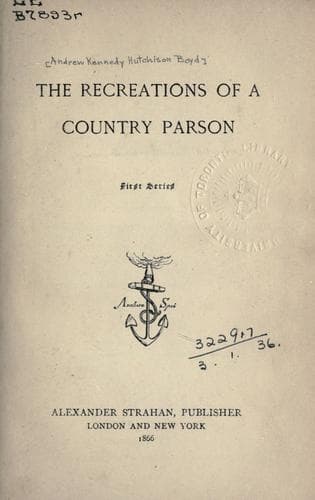
The Recreations of a Country ParsonBoyd, Andrew Kennedy Hutchison
General
The Recreations of a Country Parson
Boyd, Andrew Kennedy Hutchison
Clergy -- Anecdotes; Country life -- England; Rural clergy -- England
To be inert has the same meaning as to be dead. So we speak of
nature, thinking it to be inert, as 'dead matter.' To say that man
introduces inertness into nature implies a deadness in him: it is
to say that he wants life. This is the proposition which is affirmed.
This condition which we call our life, is not the true life of man.
The Book that has had greater influence upon the world than all
others, differs from all others, in affirming that man wants life,
and in making that statement the basis of all that it contains
respecting the past and present and future of mankind.
Science thus pays homage to the Bible. What that book has declared
as if with authority, so long ago, she has at last decyphered on
the page of nature. This is not man's true life.
And who is there who can doubt, looking at man as lie is now, and
then thinking of what he is to be in another world, that there is
about him, now, great defect? There is truly much wanting which it
is hoped will one day be supplied. What shall we call this lacking
thing--this one thing lacking whose absence is felt in every fibre
of our being? Our author chooses to call it life; I am doubtful with
how much felicity or naturalness of expression. Of course we all
know that in the New Testament life does not mean merely existence
continued; eternal life does not mean merely existence continued for
ever: it means the highest and purest form of our being continued
for ever;--happiness and holiness continued for ever. We know, too,
that holy Scripture describes the step taken by any man in becoming
an earnest believer in Christ, as 'passing from death to life;' we
remember such a text as 'This is life eternal, that they may know
Thee, the only true God, and-Jesus Christ whom Thou hast sent.'
We know that a general name for the Gospel, which grasps its grand
characteristics, is 'The Word of Life;' and that, in religious phrase,
Christianity is concerned with the revealing, the implanting, the
sustaining, the crowning, of a certain better life. Nor is it
difficult to trace out such analogies between natural and spiritual
death, between natural and spiritual life, as tend to prove that
spiritual life and death are not spoken of in Scripture merely
as the strongest words which could be employed, but that there is
a further and deeper meaning in their constant use. But I do not
see any gain in forcing figurative language into a literal use.
Everybody knows what life and death, in ordinary language, imply.
Life means sensibility, consciousness, capacity of acting, union with
the living. Death means senselessness, helplessness, separation.
No doubt we may trace analogies, very close and real, between
the natural and the spiritual life and death. But still they are
no more than analogies. You do not identify the physical with the
spiritual. And it is felt by all that the use of the words in a
spiritual sense is a figurative use. To the common understanding,
Public-domain text, read in full here on John Shaqi.
Reviews
Reviews
No reviews yet
Be the first to share your thoughts on this work.
Elsewhere in the archive
Join the Discussion
Join the discussion
Sign in to leave a comment or review.
Sign InorCreate an account