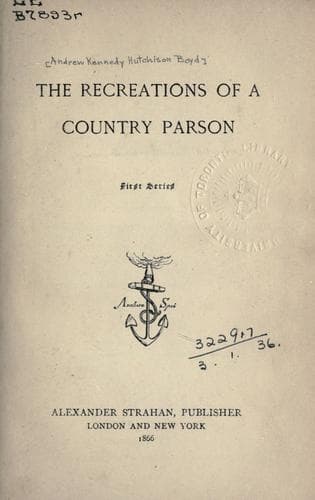
The Recreations of a Country ParsonBoyd, Andrew Kennedy Hutchison
General
The Recreations of a Country Parson
Boyd, Andrew Kennedy Hutchison
Clergy -- Anecdotes; Country life -- England; Rural clergy -- England
Such are the great lines of the new theory as to Man and his
Dwelling-Place. Thus does our author interpret Nature. I trust and
believe that I have not in any way misrepresented or caricatured
his opinions. His Introduction sets out in outline the purport of
the entire book. The remainder of the volume is given to carrying
out these opinions into detail, as they are suggested by or as they
affect the entire system of things. It is divided into four Hooks.
Book I. treats Of Science; Book II. Of Philosophy; Book III.
Of Religion; Book IV. Of Ethics; and the volume is closed by four
dialogues between the Writer and Reader, in which, in a desultory
manner, the principles already set forth are further explained and
enforced.
Early in the first chapter of the Book Of Science, the author
anticipates the obvious objection to his use of the terms Life
and Death. I do not think he succeeds in justifying the fashion in
which he employs them. But let him speak for himself:
It may seem unnatural to speak of a conscious existence as a state
of death. But what is affirmed is, that a sensational existence such
as ours is not the life of MAN; that a consciousness of physical
life does itself imply a deadness. The affirmations that we are
living men, and that man has not true and absolute life, are not
opposed. Life is a relative term. Our possession of a conscious
life in relation to the things that we feel around us, is itself
the evidence of man's defect of life in a higher and truer sense.
Let a similitude make the thought more clear. Are not we, as
individuals, at rest, steadfast in space; evidently so to our own
consciousness, demonstrably so in relation to the objects around
us? But is man at rest in space? By no means. We are all partakers
of a motion. Nay, if we were truly at rest, we could not have
this relative steadfastness, we should not beat rest to the things
around us: they would fleet and slip away. Our relative rest, and
consciousness of steadfastness, depend upon our being not at rest.
There are moving things, to which he only can be steadfast who is
moving too. Even Buch is the life of which we have consciousness.
We have a life in relation to these physical things, because man
wants life. True life in man would alter his relation to them. They
could not be the realities any more: he could not have a life in
them. As rest to moving things is not truly rest, but motion; so
life to inert things is not truly life, but deadness.
Public-domain text, read in full here on John Shaqi.
Reviews
Reviews
No reviews yet
Be the first to share your thoughts on this work.
Elsewhere in the archive
Join the Discussion
Join the discussion
Sign in to leave a comment or review.
Sign InorCreate an account