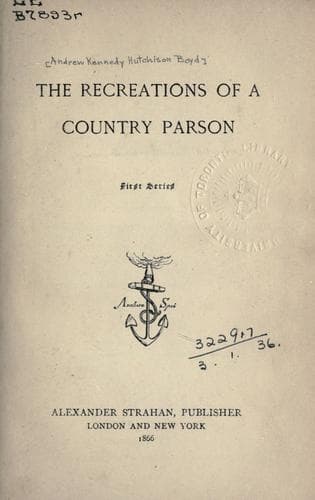
The Recreations of a Country ParsonBoyd, Andrew Kennedy Hutchison
General
The Recreations of a Country Parson
Boyd, Andrew Kennedy Hutchison
Clergy -- Anecdotes; Country life -- England; Rural clergy -- England
Very ingeniously thought out: very skilfully put, with probably the
only illustration which would go on all fours. But to me all this
is extremely unsatisfactory: and unsatisfactory in a much farther
sense than merely that it is using terms in a non-natural sense.
I know, of course, that to look at Nature through blue spectacles
will make Nature blue: but I cannot see that to look at Nature through
dead eyes should make Nature dead. I see no proof that Nature, in
fact, is living and active, though it admittedly looks inert and
dead. And I can discover nothing more than a daring assertion,
in the statement that we are dead, and that we project our own
deadness upon living nature. I cannot see how to the purest and most
elevated of beings, a tree should look less solid than it does to
me. I cannot discover how greater purity of heart, and more entire
faith in Christ, should turn this material world into a world
of spirit. I doubt the doctrine that spirit in itself, as usually
understood (apart from its power of originating action) is a higher
and holier existence than matter. It seems to me that very much
from a wrong idea that it is, come those vague, unreal, intangible
notions as to the Christian Heaven, which do so much to make it a
chilly, unattractive thing, to human wishes and hopes. It is hard
enough for us to feel the reality of the things beyond the grave,
without having the additional stumbling-block cast in our way, of
being told that truly there is nothing real there for us to feel.
As for the following eloquent passage, in which our author subsequently
returns to the justification of his great doctrine, no more need
be said than that it is rhetoric, not logic:--
That man has not his true life, must have taken him long to learn.
All our prepossessions, all our natural convictions, are opposed
to that belief. If these activities, these powers, these capacities
of enjoyment and suffering, this consciousness of free will, this
command of the material world, be not life, what is life? What more
do we want to make us truly man? This is the feeling that has held
men captive, and biased all their thoughts so that they could not
perceive what they themselves were saying.
Yet the sad undercurrent has belied the boast. From all ages and
all lands the cry of anguish, the prayer for life unconscious of
itself, has gone up to heaven. In groans and curses, in despair
and cruel rage, man pours out his secret to the universe; writing
it in blood, and lust, and savage wrong, upon the fair bosom of
the earth; he alone not knowing what he does. If this be the life
of man, what is his death?
No doubt this would form a very eloquent and effective paragraph
in a popular sermon. But in a philosophic treatise, where an author
is tied to the severely precise use of terms, and where it will
not do to call a thing death merely because it is very bad, nor
to call a thing life merely because it is vry good, the argument
appears to have but little weight.
Public-domain text, read in full here on John Shaqi.
Reviews
Reviews
No reviews yet
Be the first to share your thoughts on this work.
Elsewhere in the archive
Join the Discussion
Join the discussion
Sign in to leave a comment or review.
Sign InorCreate an account