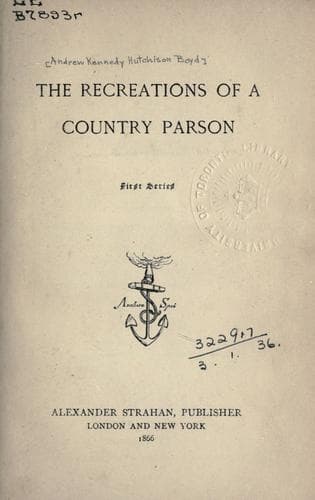
The Recreations of a Country ParsonBoyd, Andrew Kennedy Hutchison
General
The Recreations of a Country Parson
Boyd, Andrew Kennedy Hutchison
Clergy -- Anecdotes; Country life -- England; Rural clergy -- England
You must see, intelligent reader, that one thing which we are
entitled to require our author to satisfactorily prove, is the fact
that Nature is not inert, as it appears to man. If you can make
it certain that Nature is living and active, then, no doubt, some
explanation will be needful as to how it comes to look so different
to us; though, even then, I do not see that it necessarily follows
that the inertness is to be supposed to exist in ourselves. But
unless the author can prove that Nature is not inert, he has no
foundation to build on. He states three arguments, from which he
derives the grand principle:--
1. Inertness necessarily belongs to all phenomena. That which is
only felt to be, and does not truly or absolutely exist, must have
the character of inaction. It must be felt as passive A phenomenon
must be inert because it is a phenomenon. We cannot argue from
inertness in that which appears to us, to inertness in that which
is. Of whatsoever kind the essence of nature may be, if it be
unknown, the phenomenon must be equally inert. We have no ground,
therefore, in the inertness which we feel, for affirming of nature
that it is inert. We must feel it so, by virtue of our known relation
to it, as not perceiving its essence.
2. The question, therefore, rests entirely upon its own evidence.
Since we have no reason, from the inertness of the phenomenal, for
inferring the inertness of the essential, can we know whether that
essential be inert or not? We can know. Inertness, as being absolute
inaction, cannot belong to that which truly is. Being and absolute
inaction are contraries. Inertness, therefore, must be a property
by which the phenomenal differs from the essential or absolute.
3. Again, nature does act: it acts upon us, or we could not perceive
it at all. The true being of nature is active therefore. That we
feel it otherwise shows that we do not feel it as it is. We must
look for the source of nature's apparent or felt inertness in
man's condition. Never should man have thought to judge of nature
without remembering his own defectiveness.
Such are the grounds upon which rests the belief, that nature is
not inert. It appears to me that there is little force in them.
To a great extent they are mere assumptions and assertions; and
anything they contain in the nature of argument is easily answered.
First: Why must every phenomenon be felt as inert? Why must a
'phenomenon be inert because it is a phenomenon?' I cannot see why.
We know nothing but phenomena; that is, things as they appear to
us. Where did we get the ideas of life and activity, if not from
phenomena? Many things appear to us to have life and activity. That
is, there are phenomena which are not inert.
Public-domain text, read in full here on John Shaqi.
Reviews
Reviews
No reviews yet
Be the first to share your thoughts on this work.
Elsewhere in the archive
Join the Discussion
Join the discussion
Sign in to leave a comment or review.
Sign InorCreate an account