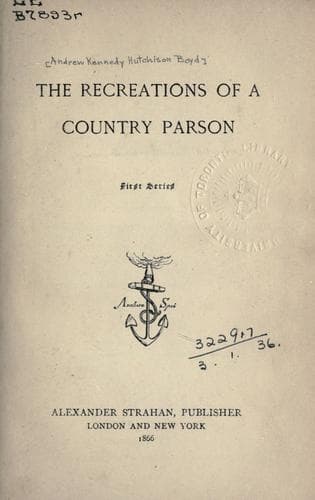
The Recreations of a Country ParsonBoyd, Andrew Kennedy Hutchison
General
The Recreations of a Country Parson
Boyd, Andrew Kennedy Hutchison
Clergy -- Anecdotes; Country life -- England; Rural clergy -- England
Fourthly: I grant that 'nature does act upon us, or we could not
perceive it at all.' But then I maintain that this kind of action
is not action as men understand the word. This kind of action is
quite consistent with the general notion of inertness. A thing may
be inert, as mankind understand the word; and also active, as the
author of this book understands the word. To discern this sort of
activity and life in nature we have no need to 'pass from death to
life' ourselves. We simply need to have the thing pointed out to
us, and it is seen at once. It is playing with words to say that
nature acts upon us, or we could not perceive it. No doubt, when
you stand before a tree, and look at it, it does act in so far as
that it depicts itself upon your retina; but that action is quite
consistent with what we understand by inertness. It does not
matter whether you say that your eye takes hold of the tree, or
that the tree takes hold of your eye. When you hook a trout, you
may say either that you catch the fish, or that the fish catches
you. Is the alternative worth fighting about? Which is the natural
way of speaking: to say that the man sees the tree, or that the tree
shows itself to the man? All the activity which our author claims
for nature goes no farther than that. Our reply is that that is
not activity at all. If that is all he contends for, we grant it at
once; and we say that it is not in the faintest degree inconsistent
with the fact of nature's being inert, as that word is understood.
You come and tell me that Mr. Smith has just passed your window
flying. I say no; I saw him; he was not flying, but walking. Ah, you
reply, I hold that walking is an indicate flying; it is a rudimentary
flying, the lowest form of flying; and therefore I maintain that he
flew past the window. My friend, I answer, if it be any satisfaction
to you to use words in that way, do so and rejoice; only do not
expect any human being to understand what you mean; and beware of
the lunatic asylum.
Why, I ask again, are we to cry down man for the sake of crying up
nature? Why are we to depreciate the dweller that we may magnify the
dwelling-place? Is not, man (to say the least) one of the works of
God? Did not God make, both man and nature? And does not Revelation
(which our author holds in so deep reverence) teach that man was
the last and noblest of the handiworks of the Creator? And thus it
is that I do not hesitate to answer such a question as that which
follows, and to answer it contrariwise to what the author expects.
It is from the human soul that glory and meaning are projected
upon inanimate nature. To Newton, and to Newton's dog, the outward
creation was physically the same; to the apprehension of Newton
and of Newton's dog, how different! Hear the author:--
Public-domain text, read in full here on John Shaqi.
Reviews
Reviews
No reviews yet
Be the first to share your thoughts on this work.
Elsewhere in the archive
Join the Discussion
Join the discussion
Sign in to leave a comment or review.
Sign InorCreate an account