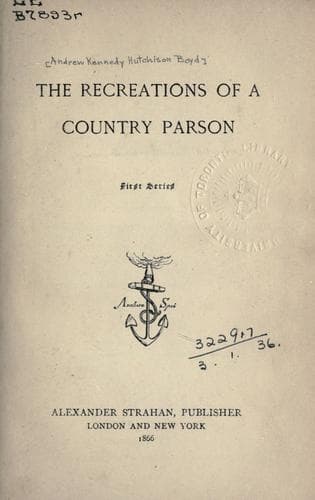
The Recreations of a Country ParsonBoyd, Andrew Kennedy Hutchison
General
The Recreations of a Country Parson
Boyd, Andrew Kennedy Hutchison
Clergy -- Anecdotes; Country life -- England; Rural clergy -- England
To this clear issue the case is brought: Man does introduce into
nature something from himself: either the inertness, the negative
qualily, the defect, or the beauty, the meaning, the glory. Either
that whereby the world is noble comes from ourselves, or that
whereby it is mean; that which it has, or that which it wants. Can
it be doubtful which it is?
Not in the least! Give me the rational and immortal man, made in
God's image, rather than the grandest oak which the June sunbeams
will be warming when you read this, my friend--rather than the most
majestic mountain which by and bye will be purple with the heather.
Reason, immortality, love, and faith, are things liker God than ever
so many cubic feet of granite, than ever so many loads of timber.
'Behold,' says Archer Butler, 'we stand alone in the universe!
Earth, air, and ocean can show us nothing so awful as we!'
You fancy, says our author, that Nature is inert, because it goes
on in so constant and unvarying a course. You know, says he, what
conscious exertion it costs you to produce physical changes; you can
trace no such exertion in Nature. You would believe, says he, that
Nature is active, but for the fact that her doings are all conformed
to laws that you can trace. But invariableness, he maintains, is
no proof of inaction. RIGHT ACTION is invariable; RIGHT ACTION is
absolutely conformed to law. Why, therefore, should not the secret
of nature's invariableness be, not passiveness, but rightness?' The
unchanging uniformity of Nature's course proves her holiness--her
willing, unvarying obedience to the Divine law. 'The invariableness
of Nature bespeaks Holiness as its cause.'
May we not think upon all this (not dogmatically) in some such
fashion as this?
Which is likelier:
1. That Nature has it in her power to vary from the well-known laws
of Nature; that she could disobey God if she pleased; but that she
is so holy that she could not think of such a thing, and so through
all ages has never swerved once. Or,
2. That Nature is bound by laws which she has not the power to
disobey; that she is what she looks, an inanimate, passive, inert
thing, actuated, as her soul and will, by the will of the Creator?
And to aid in considering which alternative is the likelier, let it
be remembered that Revelation teaches that this is a fallen world;
that experience proves that this world is not managed upon any
system of optimism; that in this creation things are constantly
going wrong; and especially, that all history gives no account of
any mere creature whose will was free to do either good or ill; and
yet who did not do ill frequently. Is it likely that to all this
there is one entire exception; one thing, and that so large a
thing as all inanimate nature, perfectly obedient, perfectly holy,
perfectly right-and all by its own free will? I grant there is
something touching in the author's eloquent words:--
Public-domain text, read in full here on John Shaqi.
Reviews
Reviews
No reviews yet
Be the first to share your thoughts on this work.
Elsewhere in the archive
Join the Discussion
Join the discussion
Sign in to leave a comment or review.
Sign InorCreate an account