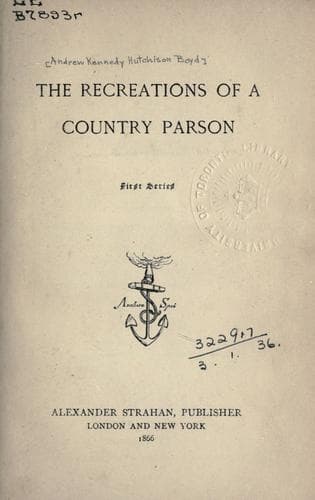
The Recreations of a Country ParsonBoyd, Andrew Kennedy Hutchison
General
The Recreations of a Country Parson
Boyd, Andrew Kennedy Hutchison
Clergy -- Anecdotes; Country life -- England; Rural clergy -- England
The writers of the New Testament declare man to be dead. They speak
of men as not having life, and tell of a life to be given them. If,
therefore, our thoughts were truly conformed to the New Testament,
how could it seem a strange thing to us that this state of man should
be found a state of death; how should its very words, reaffirmed
by science, excite our surprise? Would it not have appeared to us
a natural result of the study of nature to prove man dead? Might
we not, if we had truly accepted the words of Scripture, have
anticipated that it should be so? For, if man be rightly called
dead, should not that condition have affected his experience, and
ought not a discovery of that fact to be the issue of his labours
to ascertain his true relation to the universe? Why does it seem
a thing incredible to us that man should be really, actually dead:
dead in such a sense as truly to affect his being, and determine
his whole state? Why have we been using words which affirm him dead
in our religious speech, and feel startled at finding them proved
true in another sphere of inquiry?
It is indeed true--it is a thing to be taken as a fundamental truth
in reading the Bible--that in a certain sense man is dead, and is
to be made alive; and the analogy which obtains between natural
death and what in theological language is called spiritual death,
is in several respects so close and accurate that we feel that it
is something more than a strong figure when the New Testament says
such things as 'You hath he quickened who were dead in trespasses
and sins.' But it tends only to confusion to seek to identify
things so thoroughly different as natural and spiritual death. It
is trifling with a man to say to him 'You are dead!' and having
thus startled him, to go on to explain that you mean spiritually
dead. 'Oh,' he will reply, 'I grant you that I may be dead in that
sense, and possibly that is the more important sense, but it is
not the sense in which words are commonly understood.' I can see,
of course, various points of analogy between ordinary death and
spiritual death. Does ordinary death render a man insensible to
the presence of material things? Then spiritual death renders him
heedless of spiritual realities, of the presence of God, of the
value of salvation, of the closeness of eternity. Does natural death
appear in utter helplessness and powerlessness? So does spiritual
death render a man incapable of spiritual action and exertion. Has
natural death its essence in the entire separation it makes between
dead and living? So has spiritual death its essence in the separation
of the soul from God. But, after all, these things do but show an
analogy between natural death and spiritual: they do not show that
the things are one; they do not show that in the strict unfigurative
use of terms man's spiritual condition is one of death. They show
that man's spiritual condition is very like death; that is all. It
Public-domain text, read in full here on John Shaqi.
Reviews
Reviews
No reviews yet
Be the first to share your thoughts on this work.
Elsewhere in the archive
Join the Discussion
Join the discussion
Sign in to leave a comment or review.
Sign InorCreate an account