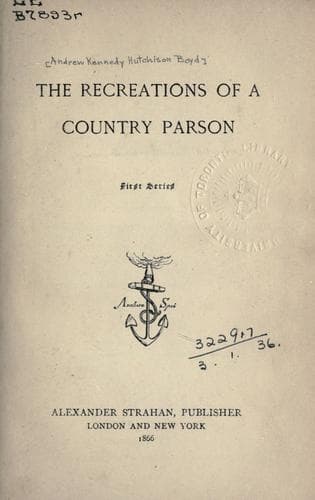
The Recreations of a Country ParsonBoyd, Andrew Kennedy Hutchison
General
The Recreations of a Country Parson
Boyd, Andrew Kennedy Hutchison
Clergy -- Anecdotes; Country life -- England; Rural clergy -- England
If it were not that the reader of Man and his Dwelling-Place is
likely, after the shock of the first grand theory, that Man is dead
and the Universe living, to receive with comparative coolness any
further views set out in the book, however strange, I should say
that probably, the third Book, 'Of Religion,' would startle him more
than anything else in the work. Although this Book stands third in
the volume, it is first both in importance and in chronology. For
the author tells us that his views Of Religion are not deduced from
the theoretical conceptions already stated, but have been drawn
immediately from the study of Scripture, and that from them the
philosophical ideas are mainly derived. And indeed it is perfectly
marvellous what doctrines men will find in Scripture, or deduce
from Scripture. Is there not something curious in the capacity of
the human mind, while glancing along the sacred volume, to find
upon its pages both what suits its prevailing mood and its firm
conviction at the time? You feel buoyant and cheerful: you open
your Bible and read it; what a cheerful, hopeful book it is! You are
depressed and anxious: you open your Bible; surely it was written
for people in your present frame of mind! It is wonderful to what
a degree the Psalms especially suit the mood and temper of all
kinds of readers in every conceivable position. I can imagine the
poor suicide, stealing towards the peaceful river, and musing on a
verse of a psalm. I can imagine the joyful man, on the morning of
a marriage day which no malignant relatives have embittered, finding
a verse which will seem like the echo of his cheerful temper. And
passing from feeling to understanding, it is remarkable how, when
a man is possessed with any strong belief, he will find, as he
reads the Bible, not only many things which appear to him expressly
to confirm his view, but something in the entire tenor of what he
reads that appears to harmonize with it. I doubt not the author
of Man and his Dwelling-Place can hardly open the Bible at random
without chancing upon some passage which he regards as confirmatory
of his opinions. I am quite sure that to ordinary men his opinions
will appear flally to conflict with the Bible's fundamental
teaching. It has already been indicated in this essay in what sense
the statements of the New Testament to the following effect are to
be understood:--
Public-domain text, read in full here on John Shaqi.
Reviews
Reviews
No reviews yet
Be the first to share your thoughts on this work.
Elsewhere in the archive
Join the Discussion
Join the discussion
Sign in to leave a comment or review.
Sign InorCreate an account