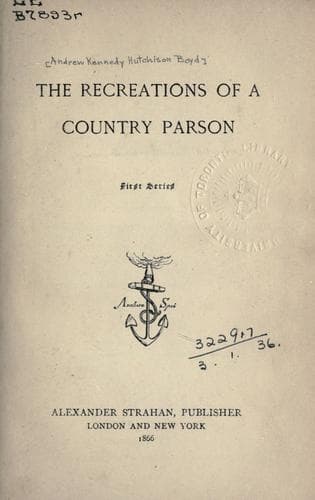
The Recreations of a Country ParsonBoyd, Andrew Kennedy Hutchison
General
The Recreations of a Country Parson
Boyd, Andrew Kennedy Hutchison
Clergy -- Anecdotes; Country life -- England; Rural clergy -- England
So here we are again among our old friends. We should have good
reason to complain had Dunsford, Ellesmere, or Milverton been absent;
and here they are again just as before. Possibly they are even
less changed than they'should have been after thirteen or fourteen
years, considering what their age was at our first introduction to
them. Dunsford, the elderly country parson, once fellow and tutor
of his college, still reports the conversations of the friends;
Milverton and Ellesmere are, in their own way, as fond of one
another as ever; Dunsford is still judicious, kind, good, somewhat
slow, as country parsons not unnaturally become; Ellesmere is
still sarcastic, keen, clever, with much real worldly wisdom and
much affected cynicism overlying a kind and honest heart. As for
Milverton, we should judge that in him the author of the work has
unconsciously shown us himself; for assuredly the great characteristics
of the author of Friends in Council must be that he is laborious,
thoughtful, generous, well-read, much in earnest, eager for
the welfare of his fellow-men, deeply interested in politics and
in history, impatient of puritanical restraints, convinced of the
substantial importance of amusement. Milverton, we gather, still
lives at his country-seat in Hampshire, and takes some interest
in rustic concerns. Ellesmere continues to rise at the bar; since
we last met him has been Solicitor-General, and is now Sir John,
a member of the House of Commons, and in the fair way to a Chief
Justiceship. The clergyman's quiet life is going on as before. But
in addition to our three old friends we find an elderly man, one
Mr. Midhurst, whose days have been spent in diplomacy, who is of a
melancholy disposition, and takes gloomy views of life, but who is
much skilled in cookery, very fat, and very fond of a good dinner.
Also Mildred and Blanche, Milverton's cousins, two sisters, have
grown up into young women of very different character: and they
take some share in the conversations, and, as we shall hereafter
see, a still more important part in the action of the story.
We feel that we are in the midst of a real group of actual human
beings:--just what third-rate historians fail to make us feel when
telling us of men and women who have actually lived. The time and
place are very varied; hut through the greater portion of the book
the party are travelling over the Continent. A further variation
from the plan of the former volumes, besides the introduction of new
characters, is, that while all the essays in the preceding series
were written by Milverton, we have now one by Ellesmere, one by
Dunsford, and one by Mr. Midhurst, each being in theme and manner
very characteristic of its author. But, as heretofore, the writer
of the book holds to his principle of the impolicy of 'jading anything
too far,' and thinks with Bacon that 'it is good, in discourse
and speech of conversation, to vary and intermingle speech of the
Public-domain text, read in full here on John Shaqi.
Reviews
Reviews
No reviews yet
Be the first to share your thoughts on this work.
Elsewhere in the archive
Join the Discussion
Join the discussion
Sign in to leave a comment or review.
Sign InorCreate an account