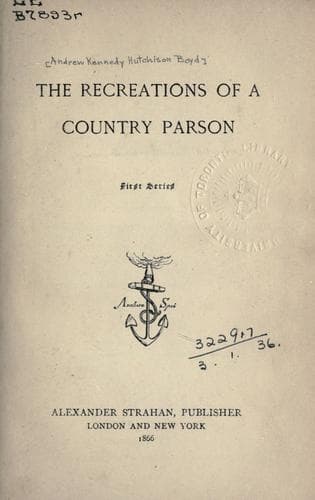
The Recreations of a Country ParsonBoyd, Andrew Kennedy Hutchison
General
The Recreations of a Country Parson
Boyd, Andrew Kennedy Hutchison
Clergy -- Anecdotes; Country life -- England; Rural clergy -- England
present occasion with arguments, tales with reasons, asking of
questions with telling of opinions, and jest with earnest.' The
writer likewise holds by that system which his own practice has done
so much to recommend--of giving locality and time to all abstract
thought, and thus securing in the case of the majority of readers
an interest and a reality in no other way to be attained. Admirable
as are the essays contained in the work, but for their setting in
something of a story, and their vivification by being ascribed to
various characters, and described as read and discussed in various
scenes, they would interest a very much smaller class of readers
than now they do. No doubt much of the skill of tho dramatist is
needed to secure this souce of interest. It can be secured only
where we feel that the characters are living men and women, and the
attempt to secure it has often proved a miserable failure. But it
is here that the author of Friends in Council succeeds so well. Not
only do we know precisely what Dunsford, Milverton, and Ellesmere
are like; we know exactly what they ought and what they ought not
to say. The author ran a risk in reproducing those old friends. We
had a right to expect in each of them a certain idiosyncrasy; and
it is not easy to maintain an individuality which does not dwell
in mere caricature and exaggeration, but in the truthful traits of
actual life. We feel we have a vested interest in the characters of
the three friends: not even their author has the right essentially
to alter them; we should feel it an injury if he did. But he has
done what he intended. Here we have the selfsame men. Not a word
is said by one of them that ought to have been said by another.
And here it may be remarked, that any one who is well read in the
author's writings, will not fail here and there to come upon what
will appear familiar to him. Various thoughts, views, and even
expressions, occur which the author has borrowed from himself. It
is easy to be seen that in all this there is no conscious repetition,
but that veins of thought and feeling long entertained have cropped
out to the surface again.
Public-domain text, read in full here on John Shaqi.
Reviews
Reviews
No reviews yet
Be the first to share your thoughts on this work.
Elsewhere in the archive
Join the Discussion
Join the discussion
Sign in to leave a comment or review.
Sign InorCreate an account