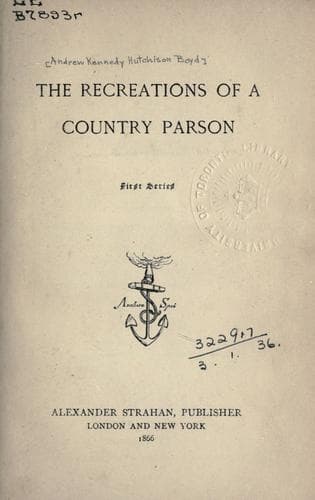
The Recreations of a Country ParsonBoyd, Andrew Kennedy Hutchison
General
The Recreations of a Country Parson
Boyd, Andrew Kennedy Hutchison
Clergy -- Anecdotes; Country life -- England; Rural clergy -- England
We do not know whether or not the readers of Friends in Council
will be startled at finding that these volumes show us the grave
Milverton and the sarcastic Ellesmere in the capacity of lovers,
and leave them in the near prospect of being married--Ellesmere to
the bold and dashing Mildred; Milverton to the quiet Blanche. The
gradual tending of things to this conclusion forms the main action
of the book. The incidents are of the simplest character: there
is a plan but no plot, except as regards these marriages. Wearied
and jaded with work at home, the three friends of the former
volumes resolve on going abroad for awhile. Midhurst and the girls
accompany them: and the story is simply that at various places to
which they came, one friend read an essay or uttered a discourse
(for sometimes the essays are supposed to have been given extempore),
and the others talked about it. But the gradual progress of matters
towards the weddings (it may be supposed that the happy couples are
this September on their wedding tours) is traced with much skill
and much knowledge of the fashion in which such things go; and it
supplies a peculiar interest to the work, which will probably tide
many young ladies over essays on such grave subjects as Government
and Despotism. Still, we confess that we had hardly regarded Ellesmere
and Milverton as marrying men. We had set them down as too old,
grave, and wise, for at least the preliminary stages. We have not
forgotten that Dunsford told us [Footnote: Friends in Council,
Introduction to Book II.] that in the summer of 1847 he supposed
no one but himself would speak of Milverton and Ellesmere as young
men; and now of course they are twelve years older, and yet about
to be married to girls whom we should judge to be about two or three
and twenty. And although it is not an unnatural thing that Ellesmere
should have got over his affection for the German Gretchen, whose
story is so exquisitely told in the Companions of my Solitude, we
find it harder to reconcile Milverton's marriage with our previous
impression of him. Yet perhaps all this is truthful to life. It is
not an unnatural thing that a man who for years has settled down
into the belief that he has faded, and that for him the romantic
interest has gone from life, should upon some fresh stimulus gather
himself up from that idea, and think that life is not so far gone
after all. Who has not on a beautiful September day sometimes chidden
himself for having given in to the impression that the season was
so far advanced, and clung to the belief that it is almost summer
still?
Public-domain text, read in full here on John Shaqi.
Reviews
Reviews
No reviews yet
Be the first to share your thoughts on this work.
Elsewhere in the archive
Join the Discussion
Join the discussion
Sign in to leave a comment or review.
Sign InorCreate an account