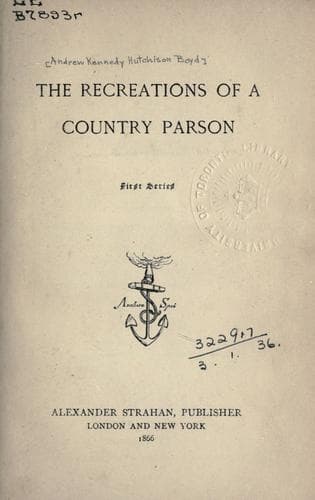
The Recreations of a Country ParsonBoyd, Andrew Kennedy Hutchison
General
The Recreations of a Country Parson
Boyd, Andrew Kennedy Hutchison
Clergy -- Anecdotes; Country life -- England; Rural clergy -- England
Who would have thought that Dunsford, with his gaiters, lying on the
grass listening cheerfully to the lively talk of his two friends,
or sitting among his bees repeating Virgil to himself, or going
about among his parishioners, the ideal of prosaic content and
usefulness, had still in him this store of old romance? In asking
the question, all we mean is to remark an apparent inconsistency:
we have no doubt at all of the philosophic truth of the representation.
Probably it is only in the finer natures that such early fancies
linger with appreciable effect. We do not forget the perpetually
repeated declarations of Mr. Thackeray; we did not read Mr. Gilfits
Love Story for nothing; we remember the very absurd incident
which is told of Dr. Chalmers, who in his last years testified
his remembrance of an early sweet-heart by sticking his card with
two wafers behind a wretched little silhouette of her. And it is
conceivable that the tenderest and most beautiful reminiscences of
a love of departed days may linger with a man who has grown grey,
fat, and even snuffy. But it is only in the case of remarkably
tidy, neat, and clever old gentlemen that such feelings are likely
to attract much sympathy from their juniors. Possibly this world
has more of such lingering romance than is generally credited.
Possibly with all but very stolid and narrow natures, no very strong
feeling goes without leaving some trace.
Pain and grief
Are transitory things no less than joy;
And though they leave us not the men we were,
Yet they do leave us.
Possibly it is not without some little stir of heart that most
thoughtful aged persons can revisit certain spots, or see certain
days return. And the affection which would have worn itself
down into dull common-place in success, by being disappointed and
frustrated, lives on in memory with diminished vividness but with
increasing beauty, which the test of actual fact can never make
prosaic. Dunsford tells Mildred what was his great inducement to
make this continental tour. Not the Rhine; not the essays nor the
conversations of his friends. At the Palace of the Luxemburg there
is a fine picture, called Les illusions perdues. It is one of the
most affecting pictures Dunsford ever saw. But that is not its
peculiar merit. One girl in the picture is the image of what Alice
was.
The chief thing I had to look forward to in this journey we are
making was, thsit we might return by way of Paris, and that I might
see that picture again. You must contrive that we do return that
way. Ellesmere will do anything to please you, and Milverton is
always perfectly indifferent as to where he goes, so that he is not
asked to see works of art, or to accompany a party of sight-seers
to a cathedral. We will go and see this picture together once; and
once I must see it alone.
Public-domain text, read in full here on John Shaqi.
Reviews
Reviews
No reviews yet
Be the first to share your thoughts on this work.
Elsewhere in the archive
Join the Discussion
Join the discussion
Sign in to leave a comment or review.
Sign InorCreate an account