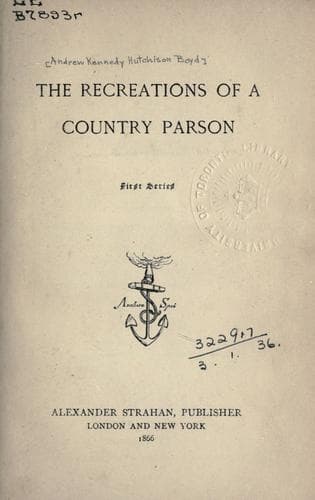
The Recreations of a Country ParsonBoyd, Andrew Kennedy Hutchison
General
The Recreations of a Country Parson
Boyd, Andrew Kennedy Hutchison
Clergy -- Anecdotes; Country life -- England; Rural clergy -- England
And a very touching sight it would be to one who knew the story,
the grey-haired old clergyman looking, for a long while, at that
young face. It would be indeed a contrast, the aged man, and the
youthful figure in the picture. Dunsford never saw Alice again after
his early disappointment: he never saw her as she grew matronly
and then old; and so, though now in her grave, she remained in his
memory the same young thing forever. The years which had made him
grow old, had wrought not the slightest change upon her. And Alice,
old and dead, was the same on the canvas still.
Dunsford's purpose in telling his love-story, was to caution Mildred
against falling in love with Milverton. She told him there was no
danger. Once, she frankly said, she had long struggled with her
feelings, not only from natural pride, but for the sake of Blanche,
who loved Milverton better and would be less able to control
her love. But she had quite got over the struggle; and though now
intensely sympathizing with her cousin, she felt she never could
resolve to marry him. So the conversation ended satisfactorily;
and then a short sentence shows us a scene, beautiful, vivid, and
complete:--
We walked home silently amidst the mellow orchards glowing ruddily
in the rays of the setting sun.
The next chapter contains an Essay and conversation on Criticism:
but its commencement shows us Dunsford still employed in the interests
of his friends. He tells Milverton that Blanche is growing fond of
him. We can hardly give Milverton credit for sincerity or judgment
in being "greatly distressed and vexed." For once, he was shamming. All
middle-aged men are much flattered and pleased with the admiration
of young girls. Milverton declared that the thing must be put a
stop to; that "the idea of a young and beautiful girl throwing her
affections away upon a faded widower like himself, was absurd."
However, as the days went on, Milverton began to be extremely
attentive to Blanche; asked her opinion about things quite beyond
her comprehension; took long walks with her, and assured Dunsford
privately that "Blanche had a great deal more in her than most
people supposed, and that she was becoming an excellent companion."
Who does not recognize the process by which clever men persuade
themselves into the belief that they are doing a judicious thing
in marrying stupid women?
The chapter which follows that on Criticism, contains a conversation
on Biography, full of interesting suggestions which our space renders
it impossible for us to quote; but we cannot forego the pleasure
of extracting the following paragraphs. It is Milverton who speaks:--
Public-domain text, read in full here on John Shaqi.
Reviews
Reviews
No reviews yet
Be the first to share your thoughts on this work.
Elsewhere in the archive