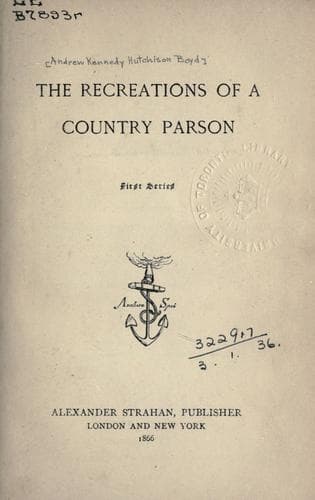
The Recreations of a Country ParsonBoyd, Andrew Kennedy Hutchison
General
The Recreations of a Country Parson
Boyd, Andrew Kennedy Hutchison
Clergy -- Anecdotes; Country life -- England; Rural clergy -- England
Now in Scotland, for very many years past, the standard style of
preaching has been that which the lively yet gentle satirist wished
to see more common in England. Whether successfully or not, Scotch
preachers aim at what Sydney Smith regarded as the right way of
preaching--'to rouse, to appeal, to inflame, to break through every
barrier, up to the very haunts and chambers of the soul.' Whether
this end be a safe one to propose to each one of some hundreds of
men of ordinary ability and taste, may be a question. An unsuccessful
attempt at it is very likely to land a man in gross offence against
common taste and common sense, from which he whose aim is less
ambitious is almost certainly safe. The preacher whose purpose is
to preach plain sense in such a style and manner as not to offend
people of education and refinement, if he fail in doing what he
wishes, may indeed be dull, but will not be absurd and offensive.
But however this may be, it is curious that this impassioned
and highly oratorical school of preaching should be found among a
cautious, cool-headed race like the Scotch. The Scotch are proverbial
for long heads, and no great capacity of emotion. Sir Walter Scott,
in Rob Roy, in describing the preacher whom the hero heard in the
crypt of Glasgow Cathedral, says that his countrymen are much more
accessible to logic than rhetoric; and that this fact determines
the character of the preaching which is most acceptable to them.
If the case was such in those times, matters are assuredly quite
altered now. Logic is indeed not overlooked: but it is brilliancy
of illustration, and, above all, great feeling and earnestness, which
go down. Mr. Caird, the most popular of modern Scotch preachers,
though possessing a very powerful and logical mind, yet owes his
popularity with the mass of hearers almost entirely to his tremendous
power of feeling and producing emotion. By way of contrast to
Sydney Smith's picture of the English pulpit manner, let us look
at one of Chalmers's great appearances. Look on that picture, and
then on this:
The Doctor's manner during the whole delivery of that magnificent
discourse was strikingly animated: while the enthusiasm and energy
he threw into some of his bursts rendered them quite overpowering.
One expression which he used, together with his action, his look, and
the tones of his voice, made a most vivid and indelible impression
on my memory... While uttering these words, which he did with peculiar
emphasis, accompanying them with a flash from his eye and a slump
of his foot, he threw his right arm with clenched fist right across
the book-board, and brandished it full in the face of the Town
Council, sitting in state before him. The words seem to startle,
like an electric shock, the whole audience.
Very likely they did: but we should regret to see a bishop, or even
a dean, have recourse to such means of producing an impression. We
shall give one other extract descriptive of Chalmers's manner:
Public-domain text, read in full here on John Shaqi.
Reviews
Reviews
No reviews yet
Be the first to share your thoughts on this work.
Elsewhere in the archive
Join the Discussion
Join the discussion
Sign in to leave a comment or review.
Sign InorCreate an account