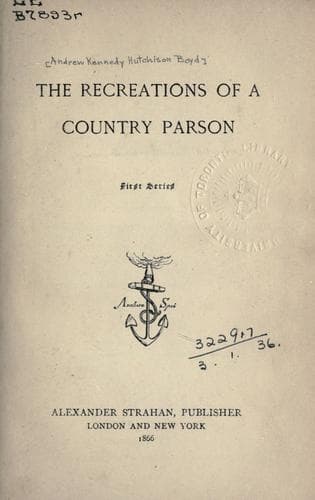
The Recreations of a Country ParsonBoyd, Andrew Kennedy Hutchison
General
The Recreations of a Country Parson
Boyd, Andrew Kennedy Hutchison
Clergy -- Anecdotes; Country life -- England; Rural clergy -- England
It was a transcendently grand, a glorious burst. The energy of his
action corresponded. Intense emotion beamed from his countenance.
I cannot describe the appearance of his face better than by saving
it was lighted up almost into a glare. The congregation were intensely
excited, leaning forward in the pews like a forest bending under
the power of the hurricane,--looking steadfastly at the preacher,
and listening in breathless wonderment. So soon as it was concluded,
there was (as invariably was the case at the close of the Doctor's
bursts) a deep sigh, or rather gasp for breath, accompanied by a
movement throughout the whole audience.
[Footnote: Life of Chalmers, vol. i. pp. 462, 3, and 467, 8. It
should be mentioned that Chahners, notwithstanding this tremendous
vehemence, always read his sermons.]
There is indeed in the Scotch Church a considerable class of most
respectable preachers who read their sermons, and who, both for
matter and manner, might be transplanted without remark into the
pulpit of any cathedral in England. There is a school, also, of
high standing and no small popularity, whose manner and style are
calm and beautiful; but who, through deficiency of that vehemence
which is at such a premium in Scotland at present, will never draw
crowds such as hang upon the lips of more excited orators. Foremost
among such stands Mr. Robertson, minister of Strathmartin, in
Forfarshire. Dr. McCulloch, of Greenock, and Dr. Veitch, of St.
Cuthbert's, Edinburgh, are among the best specimens of the class.
But that preaching which interests, leads onward, and instructs,
has few admirers compared with that which thrills, overwhelms,
and sweeps away. And from the impression made on individuals so
competent to judge as those already mentioned, it would certainly
seem that, whether suited to the dignity of the pulpit or not, the
deepest oratorical effect is made by the latter, even on cultivated
minds. Some of the most popular preachers in England have formed
themselves on the Scotch model. Melvill and M'Neile are examples:
so, in a different walk, is Ryle, so well known by his tracts.
We believe that Melvill in his early days delivered his sermons
from memory, and of late years only has taken to reading, to the
considerable diminution of the effect he produces. We may here
remark, that in some country districts the prejudice of the people
against clergymen reading their sermons is excessive. It is indeed to
be admitted that it is a more natural thing that a speaker should
look at the audience he is addressing, and appear to speak from
the feeling of the moment, than that he should read to them what
he has to say; but it is hard to impose upon a parish minister,
burdened with pastoral duty, the irksome school-boy task of committing
to memory a long sermon, and perhaps two, every week. The system
of reading is spreading rapidly in the Scotch Church, and seems
likely in a few years to become all but universal. Caird reads his
Public-domain text, read in full here on John Shaqi.
Reviews
Reviews
No reviews yet
Be the first to share your thoughts on this work.
Elsewhere in the archive
Join the Discussion
Join the discussion
Sign in to leave a comment or review.
Sign InorCreate an account