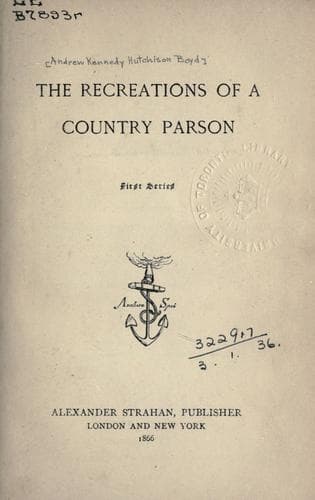
The Recreations of a Country ParsonBoyd, Andrew Kennedy Hutchison
General
The Recreations of a Country Parson
Boyd, Andrew Kennedy Hutchison
Clergy -- Anecdotes; Country life -- England; Rural clergy -- England
pauses to recover breath--much wiping of the face--sodorific results
to an unpleasant degree, necessitating an entire change of apparel
after preaching.
The secret of the superior power over a mixed congregation of the
best Scotch, as compared with most English preachers, is that the
former are not deterred by any considerations of the dignity of
the pulpit, from any oratorical art which is likely to produce an
effect. Some times indeed, where better things might be expected,
the most reprehensible clap-trap is resorted to. An English preacher
is fettered and trammelled by fear of being thought fanatical and
methodistical,--and still worse, ungentlemanlike. He knows, too,
that a reputation as a 'popular preacher' is not the thing which
will conduce much to his preferment in his profession. The Scotch
preacher, on the other hand, throws himself heart and soul into his
subject. Chalmers overcame the notion that vehemence in the pulpit
was indicative of either fanaticism or weakness of intellect:
he made ultra-animation respectable: and earnestness, even in an
excessive degree, is all in favour of a young preacher's popularity;
while a man's chance of the most valuable preferments (in the way
of parochial livings) of the Scotch church, is in exact proportion
to his popularity as a preacher. The spell of the greatest preachers
is in their capacity of intense feeling. This is reflected on the
congregation. A congregation will in most cases feel but a very
inferior degree of the emotion which the preacher feels. But intense
feeling is contagious. There is much in common between the tragic
actor and the popular preacher; but while the actor's power
is generally the result of a studied elocution, the preacher's is
almost always native. A teacher of elocution would probably say
that the manner of Chalmers, Guthrie, or Caird was a very bad one;
but it suits the man, and no other would produce a like impression.
In reading the most effective discourses of the greatest preachers,
we are invariably disappointed. We can see nothing very particular
in those quotations from Chalmers which are recorded as having so
overwhelmingly impressed those who heard them. It was manner that
did it all. In short, an accessory which in England is almost
entirely neglected, is the secret of Scotch effect. Nor is it any
derogation from an orator's genius to say that his power lies much
less in what he says than in how he says it. It is but saying that
his weapon can be wielded by no other hand than his own. Manner
makes the entire difference between Macready and the poorest stroller
that murders Shakspeare. The matter is the Baine in the case of
each. Each has the same thing to say; the enormous difference lies
in the manner in which each says it. The greatest effects recorded
to have been produced by human language, have been produced by
things which, in merely reading them, would not have appeared so
very remarkable. Hazlitt tells us that nothing so lingered on his
Public-domain text, read in full here on John Shaqi.
Reviews
Reviews
No reviews yet
Be the first to share your thoughts on this work.
Elsewhere in the archive
Join the Discussion
Join the discussion
Sign in to leave a comment or review.
Sign InorCreate an account