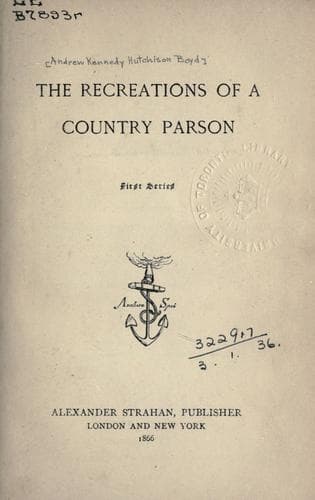
The Recreations of a Country ParsonBoyd, Andrew Kennedy Hutchison
General
The Recreations of a Country Parson
Boyd, Andrew Kennedy Hutchison
Clergy -- Anecdotes; Country life -- England; Rural clergy -- England
ear as a line from Home's Douglas, as spoken by young Betty:--
And happy, in my mind, was he that died.
We have heard it said that Macready never produced a greater effect
than by the very simple words 'Who said that?' It is perhaps a
burlesque of an acknowledged fact, to record that Whitfield could
thrill an audience by saying 'Mesopotamia!' Hugh Miller tells us
that he heard Chahners read a piece which he (Miller) had himself
written. It produced the effect of the most telling acting; and
its author never knew how fine it was till then. We remember well
the feeling which ran through us when we heard Caird say, 'As we
bend over the grave, where the dying are burying the dead.' All
this is the result of that gift of genius; to feel with the whole
soul and utter with the whole soul. The case of Gavazzi shows
that tremendous energy can carry an audience away, without its
understanding a syllable of what is said. Inferior men think by
loud roaring and frantic gesticulation to produce that impression
which genius alone can produce. But the counterfeit is wretched;
and with all intelligent people the result is derision and disgust.
Many of our readers, we daresay, have never witnessed the service
of the Scotch Church. Its order is the simplest possible. A psalm
is sung, the congregation sitting. A prayer of about a quarter of
an hour in length is offered, the congregation standing. A chapter
of the Bible is read; another psalm sung; then comes the sermon. A
short prayer and a psalm follow; and the service is terminated by
the benediction. The entire service lasts about an hour and a half.
It is almost invariably conducted by a single clergyman. In towns,
the churches now approximate pretty much to the English, as regards
architecture. It is only in country places that one finds the true
bareness of Presbytery. The main difference is that there is no
altar; the communion table being placed in the body of the church.
The pulpit occupies the altar end, and forms the most prominent
object; symbolizing very accurately the relative estimation of the
sermon in the Scotch service. Whenever a new church is built, the
recurrence to a true ecclesiastical style is marked; and vaulted
roofs, stained glass, and dark oak, have, in large towns, in a
great degree, supplanted the flat-roofed meetinghouses which were
the Presbyterian ideal. The preacher generally wears the English
preaching gown. The old Geneva gown covered with frogs is hardly
ever seen; but the surplice would still stir up a revolution. The
service is performed with much propriety of demeanour; the singing
is often so well done by a good choir, that the absence of the
organ is hardly felt. Educated Scotchmen have come to lament the
intolerant zeal which led the first Reformers in their country to
such extremes. But in the country we still see the true genius of
the Presbytery. The rustics walk into church with their hats on;
and replace them and hurry out the instant the service is over. The
Public-domain text, read in full here on John Shaqi.
Reviews
Reviews
No reviews yet
Be the first to share your thoughts on this work.
Elsewhere in the archive
Join the Discussion
Join the discussion
Sign in to leave a comment or review.
Sign InorCreate an account