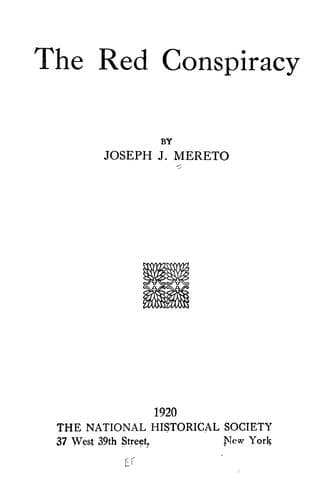
Communism; Industrial Workers of the World; Socialism
"Mistakes are being made by our peasants who, at one stroke, in the
night from October 25 to October 26 (Russian Calendar), 1917, did
away with all private ownership of land, and are now struggling,
from month to month, under the greatest difficulties, to correct
their own mistakes, trying to solve in practice the most difficult
problems of organizing a new social state, fighting, against
profiteers to secure the possession of the land, for the workers
instead of for the speculator, to carry on agricultural production
under a system of communist farming on a large scale.
"Mistakes are being made by our workmen in their revolutionary
activity, who, in a few short months, have placed practically all
the large factories and workers under state ownership, and are now
learning, from day to day, under the greatest difficulties, to
conduct the management of entire industries, to reorganize
industries already organized, to overcome the deadly resistance of
laziness and middle-class reaction and egotism."
The Socialists of the United States and other radical elements in our
country, after the World War, began to laud to the skies the Russian
Soviets as the most perfect form of government that the world had ever
seen. They were held to far surpass parliaments, congress and other
legislative bodies and to be the supreme accomplishments of a democratic
form of government. The deputies of the soviets, according to the
Bolshevist Constitution, were to be elected by the secret, direct and
equal vote of all the working masses. Theoretically the soviets were
very attractive, but in reality fall far short of the ideal. "Struggling
Russia," a well-known weekly magazine published in New York City by one
of the groups of Russian Socialists, has this to say about the Soviets
in its issue of April 5, 1919:
"In fact, there never was either a secret election in Soviet
Russia, or one based on equal suffrage. Elections are usually
conducted at a given factory or foundry at open meetings, by the
raising of hands and always under the knowing eye of the chairman.
The majority of the workers very frequently do not take part in
these elections at all. The rights of a minority are never
recognized, as proportional representation has been rejected.
Public-domain text, read in full here on John Shaqi.
Reviews
Reviews
No reviews yet
Be the first to share your thoughts on this work.
Elsewhere in the archive
Join the Discussion
Join the discussion
Sign in to leave a comment or review.
Sign InorCreate an account