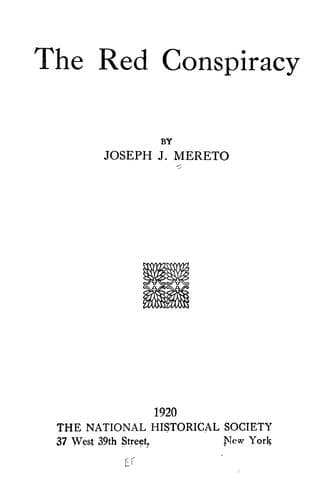
Communism; Industrial Workers of the World; Socialism
"As regards direct elections, it is again a mere phrase. The
Central Executive Committee, which is supposed to embody the
supreme administrative organ of the country, was actually being
elected through a four-grade system. Local Soviets send their
representatives to the Provincial Congress, the Provincial Congress
is represented by delegates at the All-Russian Congress, and only
this last body elects the Central Executive Committee. Often the
delegates are not elected by the regular meetings of the Soviets at
all, but are sent by the Executive Committees, cleverly handpicked
by the Bolsheviki after the system of proportional representation
was rejected....
"The exclusion from the Soviets of all who think differently from
the Bolsheviki developed gradually. They 'cleansed' the Soviets in
Perm and Ekaterinburg, in January 1918; in Ufa, Saratov, Samara,
Kazan and Yaroslavl in December, 1917; in Moscow and Petrograd in
February, 1918. They were excluding all Socialists-Revolutionists
and the Mensheviki, to say nothing of the People's Socialists and
members of the Labor Group. Often, when workers demanded new
elections to the Soviet (as happened in Petrograd late in December
of 1917, and early in January, 1918), and such elections did take
place, the Bolsheviki would not permit the newly elected delegates
to enter the building of the Soviet and frequently arrested them.
Gradually only Bolsheviki and Socialists-Revolutionists of the Left
remained in the Soviets. Soon, however, after the assassination in
Moscow of Count Mirbach, the German Ambassador, and the attempt at
rebellion in Moscow early in June, 1918, by the
Socialists-Revolutionists of the Left, the Bolsheviki began to fill
up the prisons with the latter just as they did with the
Socialists-Revolutionists of the Right and the Menshiviki.
"So, practically, there remained only Bolsheviki in the Soviets.
And as there was no difference of opinion among them, regular
meetings were soon abandoned altogether and the ostensible 'rule of
the working masses' thus definitely disappeared. A few persons,
often appointed from above (the Bolsheviki often had recourse to
bayonets to support the fiction of Soviet rule: in Tumen the
Executive Committee of a non-existent Soviet was brought from
Ekaterinburg under a convoy of 800 Red Guards), would rule and lord
it over the people, tired and weary of the war and a sterile
revolution.
Public-domain text, read in full here on John Shaqi.
Reviews
Reviews
No reviews yet
Be the first to share your thoughts on this work.
Elsewhere in the archive
Join the Discussion
Join the discussion
Sign in to leave a comment or review.
Sign InorCreate an account