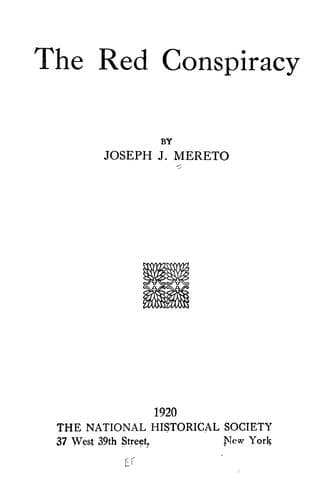
Communism; Industrial Workers of the World; Socialism
In Prague, Pressburg and other cities troops clashed with the Communists
and Social Democrats. On March 7, 1919, at a mass meeting addressed by
three leading agitators from Prague, 40,000 workers, mostly miners,
cheered assertions that the revolution of October 28, 1918, had not
turned out well for the proletariat which was still being oppressed;
that the Government of Prague was as weak as under the old Austrian
regime.
Socialism, in recent years, has made considerable progress in Sweden.
The majority of the Marxians seems to be of the moderate group, though
the Left Socialist Party assisted the Lenine Government of Russia.
Hjalmar Branting, the leader of the Moderate Socialists, addressing the
French Socialist Congress in the Spring of 1919, bitterly assailed
Bolshevism and issued a warning against it. Branting's Social-Democratic
Labor Party has 86 seats in Parliament, while the radicals, who seceded
to form the Socialist Party in 1917, have 12 seats. In this convention,
in June, 1919, the Socialist Party voted to join the Third (Moscow)
International, declared for the principle of the dictatorship of the
proletariat, voted for "mass action" as the means of conquest and a
Soviet organization of the workers.
In the Socialist party of Norway the Bolshevist faction appears to be in
control. After the revolution in Germany in the latter part of 1918, the
Norwegian Socialists, in speeches and articles urged the laborers to
organize revolutionary organizations similar to those in soviet Russia,
provide themselves with arms and be ready for a revolutionary uprising
to overthrow the government. The party congress in 1919 joined the Third
(Moscow) International and adopted "mass action" as tactics and
preparation for a general strike.
The Socialists were very active in Argentina after the ending of the
World War and were the back-bone of the serious and prolonged
disturbances in Buenos Aires. In the latter part of April, 1919, the
Pan-American Socialist Conference was held in the Argentine capital. Its
purpose was to promote the amalgamation of all the Socialist and labor
organizations of the Western Hemisphere into one body. In South America
Socialism is best organized in Argentine, Chile and Peru, and weakest in
Brazil and Colombia.
In Canada, at least till the summer of 1919, the Marxian forces were
gaining in strength daily. This was especially true of the western part
of the Dominion, where the radical industrial union, generally called in
Canada the "One Big Union," has become very influential. Serious strikes
with Bolshevist tendencies took place throughout the Dominion,
especially in Winnipeg in the spring of 1919.
Bulgaria has two Socialist parties, the Moderates and the Communist
Party, the latter affiliated with the Third (Moscow) International. In
the August, 1919, election the Moderate Socialist members in the
"Sobranie" or Chamber of Deputies decreased from 46 to 39, while the
Communists increased their Deputies from 10 to 47.
Public-domain text, read in full here on John Shaqi.
Reviews
Reviews
No reviews yet
Be the first to share your thoughts on this work.
Join the Discussion
Join the discussion
Sign in to leave a comment or review.
Sign InorCreate an account