It is a strange instinct that prompts these creatures to devote their
lives to their city, taking no smallest thought for their individual
good, without even the call of maternity or sex to guide them. Only the
queen knows motherhood. The others know nothing but toil, for purposes
they do not understand, and to an end of which they cannot dream. At
intervals all over the world of Burl's time these ant-cities rose above
the surrounding ground, some small and barely begun, and others ancient
colonies which were truly the continuation of cities first built when
the ants were insects to be crushed beneath the feet of men. These
ancient strongholds towered two, three, and even four hundred feet above
the plains, and their inhabitants would have had to be numbered in
millions if not billions.
Not all the earth was subject to the ants, however. Bees and wasps and
more deadly creatures crawled over and flew above its surface. The bees
were four feet and more in length. And slender-waisted wasps darted here
and there, preying upon the colossal crickets that sang deep bass music
to their mates--and the length of the crickets was the length of a man,
and more.
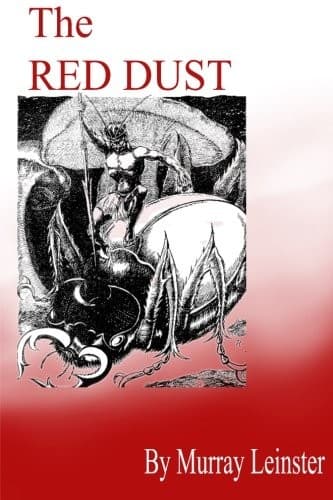
Spiders with bloated bellies waited, motionless, in their snares, whose
threads were the size of small cables, waiting for some luckless giant
insect to be entangled in the gummy traps. And butterflies fluttered
over the festering plains of this new world, tremendous creatures whose
wings could only be measured in terms of yards.
An outcropping of rock jutted up abruptly from a fungus-covered plain.
Shelf-fungi and strangely colored molds stained the stone until the
shining quartz was hidden almost completely from view, but the whole
glistened like tinted crystal from the dank wetness of the night. Little
wisps of vapor curled away from the slopes as the moisture was taken up
by the already moisture-laden air.
Seen from a distance, the outcropping of rock looked innocent and still,
but a nearer view showed many things.
Here a hunting wasp had come upon a gray worm, and was methodically
inserting its sting into each of the twelve segments of the faintly
writhing creature. Presently the worm would be completely paralyzed, and
would be carried to the burrow of the wasp, where an egg would be laid
upon it, from which a tiny maggot would presently hatch. Then weeks of
agony for the great gray worm, conscious, but unable to move, while the
maggot fed upon its living flesh--
There the tiny spider, youngest of hatchlings, barely four inches
across, stealthily stalked some other still tinier mite, the little,
many-legged larva of the oil-beetle, known as the bee-louse. The almost
infinitely small bee-louse was barely two inches long, and could easily
hide in the thick fur of a great bumblebee.
Public-domain text, read in full here on John Shaqi.
Reviews
Reviews
No reviews yet
Be the first to share your thoughts on this work.
Join the Discussion
Join the discussion
Sign in to leave a comment or review.
Sign InorCreate an account