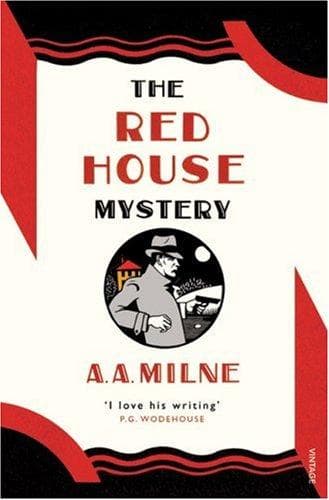
The Red House MysteryMilne, A. A. (Alan Alexander)
General
The Red House Mystery
Milne, A. A. (Alan Alexander)
Detective and mystery stories; England -- Fiction
At about the time when the Major (for whatever reasons) was fluffing
his tee-shot at the sixteenth, and Mark and his cousin were at their
business at the Red House, an attractive gentleman of the name of
Antony Gillingham was handing up his ticket at Woodham station and
asking the way to the village. Having received directions, he left his
bag with the station-master and walked off leisurely. He is an
important person to this story, so that it is as well we should know
something about him before letting him loose in it. Let us stop him at
the top of the hill on some excuse, and have a good look at him.
The first thing we realize is that he is doing more of the looking than
we are. Above a clean-cut, clean-shaven face, of the type usually
associated with the Navy, he carries a pair of grey eyes which seem to
be absorbing every detail of our person. To strangers this look is
almost alarming at first, until they discover that his mind is very
often elsewhere; that he has, so to speak, left his eyes on guard,
while he himself follows a train of thought in another direction. Many
people do this, of course; when, for instance, they are talking to one
person and trying to listen to another; but their eyes betray them.
Antony’s never did.
He had seen a good deal of the world with those eyes, though never as a
sailor. When at the age of twenty-one he came into his mother’s money,
£400 a year, old Gillingham looked up from the “Stockbreeders’ Gazette”
to ask what he was going to do.
“See the world,” said Antony.
“Well, send me a line from America, or wherever you get to.”
“Right,” said Antony.
Old Gillingham returned to his paper. Antony was a younger son, and, on
the whole, not so interesting to his father as the cadets of certain
other families; Champion Birket’s, for instance. But, then, Champion
Birket was the best Hereford bull he had ever bred.
Antony, however, had no intention of going further away than London.
His idea of seeing the world was to see, not countries, but people; and
to see them from as many angles as possible. There are all sorts in
London if you know how to look at them. So Antony looked at them—from
various strange corners; from the view-point of the valet, the
newspaper-reporter, the waiter, the shop-assistant. With the
independence of £400 a year behind him, he enjoyed it immensely. He
never stayed long in one job, and generally closed his connection with
it by telling his employer (contrary to all etiquette as understood
between master and servant) exactly what he thought of him. He had no
difficulty in finding a new profession. Instead of experience and
testimonials he offered his personality and a sporting bet. He would
take no wages the first month, and—if he satisfied his employer—double
wages the second. He always got his double wages.
Public-domain text, read in full here on John Shaqi.
Reviews
Reviews
No reviews yet
Be the first to share your thoughts on this work.
Join the Discussion
Join the discussion
Sign in to leave a comment or review.
Sign InorCreate an account