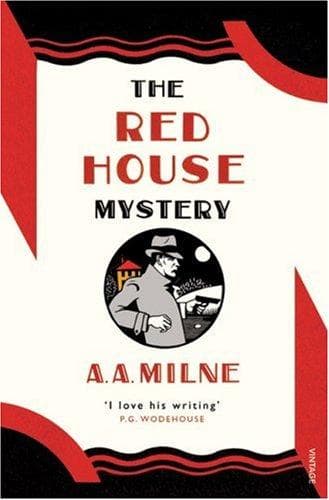
The Red House MysteryMilne, A. A. (Alan Alexander)
General
The Red House Mystery
Milne, A. A. (Alan Alexander)
Detective and mystery stories; England -- Fiction
“We don’t know anything of the sort,” protested Bill.
“We know for the purposes of our search. Obviously we can’t go tailing
into Cayley’s bedroom and tapping his wardrobes; and obviously,
therefore, if we are going to look for it at all, we must assume that
it doesn’t begin there.”
“Oh, I see.” Bill chewed a piece of grass thoughtfully. “Anyhow, it
wouldn’t begin on an upstairs floor, would it?”
“Probably not. Well, we’re getting on.”
“You can wash out the kitchen and all that part of the house,” said
Bill, after more thought. “We can’t go there.”
“Right. And the cellars, if there are any.”
“Well, that doesn’t leave us much.”
“No. Of course it’s only a hundred-to-one chance that we find it, but
what we want to consider is which is the most likely place of the few
places in which we can look safely.”
“All it amounts to,” said Bill, “is the living-rooms
downstairs—dining-room, library, hall, billiard-room and the office
rooms.”
“Yes, that’s all.”
“Well, the office is the most likely, isn’t it?”
“Yes. Except for one thing.”
“What’s that?”
“Well, it’s on the wrong side of the house. One would expect the
passage to start from the nearest place to which it is going. Why make
it longer by going under the house first?”
“Yes, that’s true. Well, then, you think the dining-room or the
library?”
“Yes. And the library for choice. I mean for _our_ choice. There are
always servants going into dining-rooms. We shouldn’t have much of a
chance of exploring properly in there. Besides, there’s another thing
to remember. Mark has kept this a secret for a year. Could he have kept
it a secret in the dining-room? Could Miss Norris have got into the
dining-room and used the secret door just after dinner without being
seen? It would have been much too risky.”
Bill got up eagerly.
“Come along,” he said, “let’s try the library. If Cayley comes in, we
can always pretend we’re choosing a book.”
Antony got up slowly, took his arm and walked back to the house with
him.
The library was worth going into, passages or no passages. Antony could
never resist another person’s bookshelves. As soon as he went into the
room, he found himself wandering round it to see what books the owner
read, or (more likely) did not read, but kept for the air which they
lent to the house. Mark had prided himself on his library. It was a
mixed collection of books. Books which he had inherited both from his
father and from his patron; books which he had bought because he was
interested in them or, if not in them, in the authors to whom he wished
to lend his patronage; books which he had ordered in beautifully bound
editions, partly because they looked well on his shelves, lending a
noble colour to his rooms, partly because no man of culture should ever
be without them; old editions, new editions, expensive books, cheap
books—a library in which everybody, whatever his taste, could be sure
of finding something to suit him.
Public-domain text, read in full here on John Shaqi.
Reviews
Reviews
No reviews yet
Be the first to share your thoughts on this work.
Join the Discussion
Join the discussion
Sign in to leave a comment or review.
Sign InorCreate an account