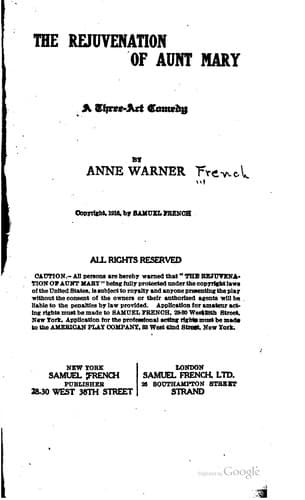
Families -- Fiction; Humorous stories; Man-woman relationships -- Fiction; New York (N.Y.) -- Fiction; Older people -- Fiction
“I expect you are to take me into dinner,” she said; and at her words
the man who had been talking to her murmured something meaningless and
got out of their way.
“I believe so,” he said.
She rose and he noticed that the top of her head was just level with
his coat lapel. He wondered, with a miserable pang, where she came to
on her husband’s coat and with the wonder his surging strength surged
suddenly out to sea again and left him feeling like Samson when he
awoke to the realization of his haircut.
“Dinner’s very late,” she said, quite as if life presented no problem
whatever; “you see, it’s the first big company in the house. We were
only seventeen last night, and to-night we’re forty-five. It makes a
difference.”
“I can imagine so,” he said. He was suddenly acutely aware of feeling
very awkward, and of finding her different—quite different from what
she had seemed up in her brother’s room.
“What is it?” she asked after a minute, looking up at him; and then she
showed that she was conscious of the change, for she added: “Something
has happened; Bob has been saying mean things about me to you?”
“Yes, he did tell me something,” he admitted; and just then the butler
announced dinner.
“What did he tell you?” she asked, as they moved away. “How could he
say anything worse than what he said before me?”
“He told me something that was worse—much worse.”
She looked troubled and as if she did not understand.
“But he said that I was a flirt, and that I couldn’t speak the truth,
and that I drove people—”
“Yes, I remember all that; but this was infinitely worse.”
“Infinitely worse!”
“Yes.”
She stopped in an angle where the big room dwindled into a narrow
gallery, and stared astonished.
“I can’t at all understand,” she said.
“No, you can’t,” he said, “and I can’t tell you—I mustn’t tell you—how
terrible it is to me to look at you and think of what he told me.”
After a second she went on again and presently they entered the
dining-room. The confusion of rustling skirts and sliding chairs quite
covered their speech for a moment and made them seem almost alone. Her
hand had been resting on his arm and now she drew it out, looking up at
him again as she did so. Her eyes had a premonitory mist over them.
“For Heaven’s sake,” she said very earnestly, “tell me what he said?”
He was silent.
“Tell me,” she pleaded.
He was still silent.
“Tell me,” she said imperiously.
He continued silent. They sat down.
“Mr. Denham,” she said, as she took up her napkin, and her voice grew
very low, and yet he heard, “I don’t think that we can pretend to be
joking any longer. You are my brother’s friend, and I am a married
woman. Please treat me as you should.”
“That’s just it,” said Jack; “that’s all there is to it. It wouldn’t
have amounted to anything except for that—or perhaps, if it hadn’t been
for that, it might have amounted to a great deal.”
“If it hadn’t been for what?”
“For your being married.”
She quite started in her seat.
Public-domain text, read in full here on John Shaqi.
Reviews
Reviews
No reviews yet
Be the first to share your thoughts on this work.
Join the Discussion
Join the discussion
Sign in to leave a comment or review.
Sign InorCreate an account