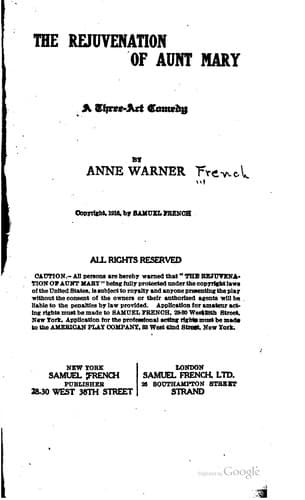
Families -- Fiction; Humorous stories; Man-woman relationships -- Fiction; New York (N.Y.) -- Fiction; Older people -- Fiction
“He’s no boy,” she said. “He’s almost twenty-two years old. He’s a
man.”
“Some are men at twenty-two, and some are boys,” Holloway remarked. “I
was a man before I was eighteen—a man out in the world of men. But
Denham’s a boy.”
He rose as he spoke, and she held out her hand for him to raise her,
too.
“It’s early to go,” she remarked parenthetically.
“I know,” he replied; “but I hear someone being shown into the
drawing-room. I don’t feel formal to-day, and if I can’t lounge in here
alone with you I’d rather go.”
“How egotistical!” she commented.
“I am egotistical,” he admitted.
And went.
The footman passed him in the hall; he had a card upon his silver
salver, and was seeking his mistress in the library. But when he
entered there the room was empty. Mrs. Rosscott had slipped through the
blue velvet portières, expecting to see a friend, and had stopped short
on the other side, amazed at finding herself face to face with an utter
stranger.
“I gave the man my card,” said the stranger, in a tone as faded as his
mustache. He was a long, thin man, but what the Germans style “_sehr
korrect_.”
“I didn’t wait to get it,” the hostess said. “I supposed that, of
course, it was somebody that I knew.”
“That was natural,” he admitted.
There was a slight pause of awkwardness.
“Won’t you sit down?” she asked.
“Certainly,” said the caller, and sat down.
Then she sat down, too, and another awkward pause ensued.
“You didn’t expect to see me, did you?” said the stranger, smiling.
“No, I didn’t,” said Mrs. Rosscott frankly. “I expected to see someone
else—someone that I knew. Nearly all my visitors are people whom I
know.”
Her eyes rather demanded an observance of the conventionalities while
her words were putting the best face possible on the queer five
minutes. The stranger smiled.
“My name is Clover,” he said then. “Of course, as you never saw me
before, you want to know that first of all.”
“I’d choose to know,” she said. And then the uncompromising neutrality
of her expression deepened so plainly that he hastened to add:
“I’m H. Wyncoop Clover.”
“Oh!” she said. And then smiled, too; having heard the name before.
“Why don’t you ask me my business?” went on H. Wyncoop Clover. “I must
have come for some reason, you know.”
“I didn’t know it,” said Mrs. Rosscott—“I don’t know anything about you
yet.”
They both smiled—and then H. Wyncoop resumed his colorless sobriety at
once.
“It’s about Jack,” he said—“these terrible new developments—” he
stopped short, seeing his _vis-à-vis_ turn deathly white, “it’s nothing
to be frightened over,” he said reassuringly.
Mrs. Rosscott was furious with herself for having paled. She became
instantly haughty.
“I was alarmed for my brother,” she said. “I always think of them both
as together.”
“Oh, in that case, I can reassure you instantly,” said the caller.
“Burnett is doing finely.”
Public-domain text, read in full here on John Shaqi.
Reviews
Reviews
No reviews yet
Be the first to share your thoughts on this work.
Join the Discussion
Join the discussion
Sign in to leave a comment or review.
Sign InorCreate an account