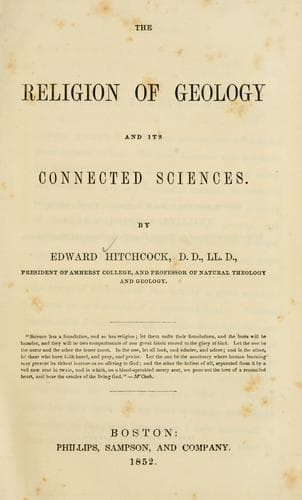
The Religion of Geology and Its Connected SciencesHitchcock, Edward
Religion
The Religion of Geology and Its Connected Sciences
Hitchcock, Edward
Bible and geology; Religion and science
Calculations have indeed been made, which seemed to show that the ark was
capacious enough to hold the pairs and septuples of all the species. But,
unfortunately, the number of species assumed to exist by the calculators
was vastly below the truth. It amounted only to three or four hundred;
whereas the actual number already described by zoologists is not less than
one hundred and fifty thousand; and the probable number existing on the
globe is not less than half a million. And for the greater part of these
must provision have been made, since most of them inhabit either the air
or the dry land. A thousand species of mammalia, six thousand species of
birds, two thousand species of reptiles, and one hundred and twenty
thousand species of insects are already described, and must have been
provided with space and food. Will any one believe this possible, in a
vessel not more than four hundred and fifty feet long, seventy-five feet
broad, and forty-five feet high?
The third and most important objection to this universality of the deluge
is derived from the facts brought to light by modern science, respecting
the distribution of animals and plants on the globe.
It was the opinion of Linnaeus that all animals and plants had their
commencement in a particular region of the earth, from whence they
migrated into all other parts of its surface. And had no new facts come to
light since his day, to change the aspect of the subject, one would
hesitate long before adopting views opposed to so distinguished a
naturalist. But new facts, in vast numbers, have been multiplying ever
since his day, and zoologists and botanists now almost universally adopt
the opinion, early promulgated by Dr. Prichard, in his admirable work on
the Physical History of Man, that there must have been several centres of
creation, from which the animals and plants radiated only so far as the
climate and food were adapted to their natures, except a few species
endowed with the power of accommodating themselves to all climates.
Certain it is that they are now thus distributed; and it is inevitable
death for most species to venture beyond certain limits. If tropical
animals and plants, for instance, were to migrate to the temperate zones,
and especially to the frigid regions, they could not long survive; and
almost equally fatal would it be for the animals and plants of high
latitudes to take up their abode near the equator. But even within the
tropics we find distinct species of animals and plants on opposite
continents. Indeed, naturalists reckon a large number of botanical and
zoological districts, or provinces, as they are called, within which they
find certain peculiar groups of animals and plants, with natures exactly
adapted to that particular district, but incapable of enduring the
different climate of adjoining districts. They differ considerably as to
the number of these districts, because the plants and animals of our globe
Public-domain text, read in full here on John Shaqi.
Reviews
Reviews
No reviews yet
Be the first to share your thoughts on this work.
Elsewhere in the archive
Join the Discussion
Join the discussion
Sign in to leave a comment or review.
Sign InorCreate an account