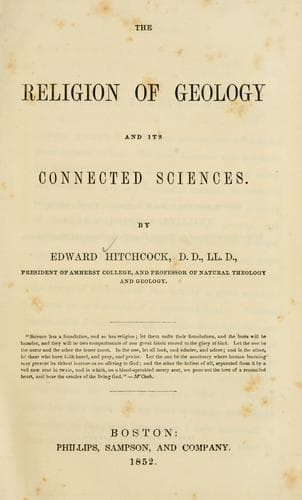
The Religion of Geology and Its Connected SciencesHitchcock, Edward
Religion
The Religion of Geology and Its Connected Sciences
Hitchcock, Edward
Bible and geology; Religion and science
are by no means yet fully described, and because the districts assigned to
the different classes do not fully coincide; but as to the existence of
such a distribution, they are of one opinion. The most reliable divisions
of this kind make twenty-five botanical provinces, and five kingdoms and
fourteen provinces among animals.[10]
The fact that man, and some of the domesticated animals, and a few plants,
are found in almost every climate, has, until recently, blinded the eyes
of naturalists to the manner in which the great mass of animals and plants
are confined within certain prescribed limits. But so soon as the general
fact is stated, we immediately recur to abundant proof of its truth. We
should be disposed to question the veracity of that traveller who should
visit a new and remote country, and describe its vegetable and animal
productions as essentially the same as in our own; and all because the
analogy of other portions of the globe leads us to expect that a new
geographical province shall present us with a peculiar _fauna_ and
_flora_; that is, with peculiar groups of animals and plants.
It is obvious that the facts which have been stated have an important
bearing upon the mode in which the animals were brought together to enter
the ark, and were afterwards distributed through the earth, if the deluge
were universal. Certain it is that, without miraculous preservation, they
could never have been brought together, nor again dispersed. We have
reason to suppose that the ark was constructed in some part of the
temperate zone. Now, suppose the animals of the torrid zone at the present
day to attempt, by natural means, to reach the temperate zone; who does
not know that nearly all of them must perish? Nor is it any easier to
conceive how, after the flood, they could have migrated into all
continents, and islands, and climates, and how each species should have
found the place exactly fitted to its constitution, as we now find them.
Indeed, the idea of their collection and dispersion in a natural way is
altogether too absurd to be believed. And we must, therefore, resort to a
miracle, or suppose a new creation to have taken place after the deluge,
or admit the flood to have been limited. If the latter supposition be not
inconsistent with the Bible, it completely relieves the difficulty. If we
suppose the limited region of Central Asia, where man existed, to have
been deluged, and pairs and septuples of the most common animals in that
region only to have been kept alive in the ark, the entire account will
harmonize with natural history. The question, then, whether such a view is
consistent with the Bible, becomes of great interest; and to this point I
beg leave next to direct your attention.
Public-domain text, read in full here on John Shaqi.
Reviews
Reviews
No reviews yet
Be the first to share your thoughts on this work.
Elsewhere in the archive
Join the Discussion
Join the discussion
Sign in to leave a comment or review.
Sign InorCreate an account