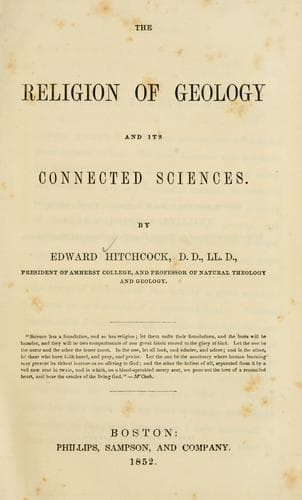
The Religion of Geology and Its Connected SciencesHitchcock, Edward
Religion
The Religion of Geology and Its Connected Sciences
Hitchcock, Edward
Bible and geology; Religion and science
In the second place, in all ages and nations, and especially among
ancient ones, "universal terms are often used to signify only a very large
amount in number or quantity."--Dr. Smith, _Scrip. and Geol._ p. 212, 4th
ed.--The Hebrew [Hebrew], (_kol_,) the [Greek: pas], and the English
_all_, are alike employed in this manner, to signify _many_. There are
some very striking cases of this sort in the Bible. Thus in Genesis it is
said that _all countries came into Egypt to Joseph to buy corn, because
the famine was sore in all lands_. This certainly could apply only to the
well-known countries around Egypt; for transportation would have been
impossible to the remotest parts of the habitable globe. In the account of
the plagues that came upon Egypt, it is said that _the hail smote every
herb of the field, and brake every tree of the field_; but, in a few days
afterwards, it is said of the locusts that _they did eat every herb of the
land and all the fruit of the trees which the hail had left_. _This day_,
said God to the Israelites, while yet in their journeyings, _will I begin
to put the fear of thee and the dread of thee upon the face of the nations
under all the heavens_. But it is obvious that only the nations contiguous
to the Israelites, chiefly the Canaanites, are here meant. In the New
Testament, it is said that, at the time of the pentecost, there were
dwelling at Jerusalem _Jews, devout men, out of every nation under
heaven_. Yet, in the enumeration, which follows this passage, of the
different places from which those Jews had come, we find only a region
extending from Italy to Persia, and from Egypt to the Black Sea. It could
have been a district of only about that size which Paul meant, when he
said to the Colossians that the _gospel was preached to every creature
which is under heaven_. In the First Book of Kings, it is said that _all
the earth sought the presence of Solomon, to hear his wisdom_;--a passage
which requires as much limitation as the others above quoted. A similar
mode of expression is employed by Christ, when he says of the queen of
Sheba that she came from _the uttermost parts of the earth to hear the
wisdom of Solomon_; for her residence, being probably on the Arabian Gulf,
could not have been more than twelve or fourteen hundred miles from
Jerusalem. A like figurative mode of speech is employed in the description
of Peter's vision, in which he saw a great sheet let down to the earth,
_wherein were all manner of four-footed beasts of the earth, and wild
beasts, and creeping things, and fowls of the air_. Who will suppose,
since it is wholly unnecessary for the object, which was to convince Peter
that the Mosaic distinction into clean and unclean beasts was abolished,
that he here had a vision of all the species of terrestrial vertebral
animals on the globe?
Public-domain text, read in full here on John Shaqi.
Reviews
Reviews
No reviews yet
Be the first to share your thoughts on this work.
Elsewhere in the archive
Join the Discussion
Join the discussion
Sign in to leave a comment or review.
Sign InorCreate an account