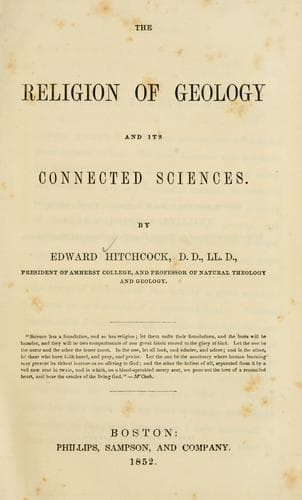
The Religion of Geology and Its Connected SciencesHitchcock, Edward
Religion
The Religion of Geology and Its Connected Sciences
Hitchcock, Edward
Bible and geology; Religion and science
If we understand the scriptural account to denote a literal universality,
it is certainly very natural to inquire why such universality was
necessary, since the deluge is represented as a penal infliction upon man.
For it seems difficult to believe as some writers have attempted to prove,
that the human family had become very numerous, or had extended far beyond
the spot where they were first planted, in less than two thousand years;
especially when we recollect how few were the children of patriarchs whose
age amounted to many centuries, and how very probable it is that the
extreme wickedness of most of the antediluvians tended to their extinction
rather than their multiplication. Why, then, for the sake of destroying
man, occupying probably only a limited portion of one continent, was it
necessary to depopulate all other continents and islands, inhabited only
by irresponsible animals, who had no connection with man? If the
Scriptures unequivocally declare that such was the fact, we are bound to
believe it on divine testimony. But if their language admits of a
different interpretation, it seems reasonable to adopt it.
And here I am willing to acknowledge that the language of the Bible on
this subject seems, at first view, to teach the universality of the flood,
unequivocally. _The waters_, say they, _prevailed exceedingly upon the
earth, and all the high hills that were under the whole heaven were
covered._ Again: _Behold, I, even I, do bring a flood of waters upon the
earth to destroy all flesh, wherein is the breath of life, from under
heaven; and every thing that is in the earth shall die._ If such language
be interpreted by the same rules which we should apply to a modern
composition, it could in no way be understood to teach a limited deluge or
a partial destruction. But in respect to this ancient record, two
considerations are to be carefully weighed.
In the first place, the terms employed are not to be judged of by the
state of knowledge in the nineteenth century, but by its state among the
people to whom this revelation was first addressed. When the earth was
spoken of to that people, (the ancient Jews,) they could not have
understood it to embrace a much wider region than that inhabited by man,
because they could not have had any idea of what lay beyond those limits.
And so of the phrase _heaven_; it must have been coextensive with the
inhabited earth only. And when it was said that all animals would die by
the deluge, they could not have supposed the declaration to embrace
creatures far beyond the dwellings of men, because they knew nothing of
such regions. Why, then, may we not attach the same limited meaning to
these declarations? Why should we suppose that the Holy Spirit used terms,
adapted, indeed, to the astronomy and geography of the nineteenth century,
but conveying only a false idea to those to whom they were addressed?
Public-domain text, read in full here on John Shaqi.
Reviews
Reviews
No reviews yet
Be the first to share your thoughts on this work.
Elsewhere in the archive
Join the Discussion
Join the discussion
Sign in to leave a comment or review.
Sign InorCreate an account