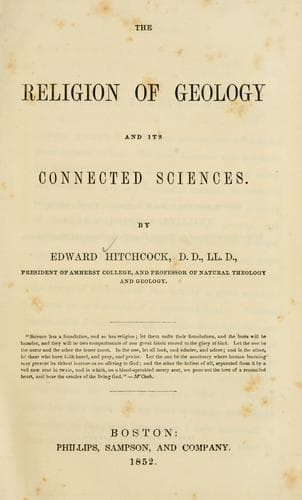
The Religion of Geology and Its Connected SciencesHitchcock, Edward
Religion
The Religion of Geology and Its Connected Sciences
Hitchcock, Edward
Bible and geology; Religion and science
In favor of this supposition, I might have urged another consideration,
which, in my mind, has no little weight. It is impossible that the waters
of the deluge should have covered the earth for a year, without destroying
nearly all the existing vegetation. Yet nothing is said of the
preservation of seeds in the ark; and if they had been preserved,
certainly nothing but miraculous power, and that of the most remarkable
kind, could have scattered them through the remotest continents and
islands, so as to form distinct botanical districts, such as have been
described. The olive, from which a leaf was plucked by the dove sent out
of the ark, was probably situated upon elevated ground, and where it
remained but a short time beneath the waters, and therefore did not lose
its vitality.
It is probable that the theory which makes the deluge limited in extent
will meet with more favor than any other, with candid and intelligent men,
to meet the suggested difficulties of the case. But some, who are
unwilling to abandon the idea of the universality of the deluge, avoid
these difficulties by supposing a new creation to have taken place at that
epoch. That such a new creation occurred at the commencement of several
geological periods can hardly admit a doubt. And a presumption is hence
derived in favor of a similar act at the beginning of the postdiluvian
period, preceded as it was, like the other geological periods, by an
almost entire destruction of organic life.
The principal objection to this view is, that no notice is taken of such a
new creation in the Bible. And it would seem that an event of so much
importance would hardly be passed in silence; and yet the bringing into
existence new races of the inferior animals and plants could have but
little bearing upon the object of revelation, which respects almost
exclusively the spiritual condition of man. One, however, can hardly see
why pairs and septuples of the animals, even in a limited district, need
to have been preserved in the ark, if a new creation were to follow the
coming catastrophe; nor why the creation of the antediluvian animals, so
soon to perish, should have been so particularly described, while no
notice was taken of the postdiluvian races, which were to occupy the earth
so much longer time.
Public-domain text, read in full here on John Shaqi.
Reviews
Reviews
No reviews yet
Be the first to share your thoughts on this work.
Elsewhere in the archive
Join the Discussion
Join the discussion
Sign in to leave a comment or review.
Sign InorCreate an account