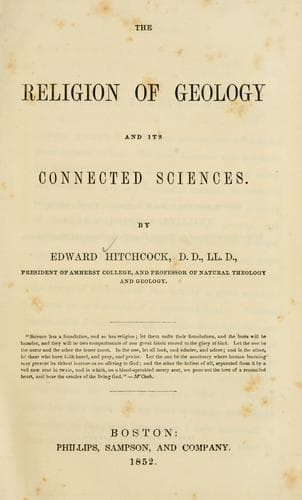
The Religion of Geology and Its Connected SciencesHitchcock, Edward
Religion
The Religion of Geology and Its Connected Sciences
Hitchcock, Edward
Bible and geology; Religion and science
A third theory has been suggested by some, embracing both those which have
been described. They admit the deluge to have been of limited extent, but
suppose this limitation not to be sufficient to explain all the facts of
revelation and of science, without a new creation also, at the
commencement of the postdiluvian period. They suppose, indeed, that
geology and natural history teach the occasional extinction of species,
and the creation of others, even in our own times. And in regard to this
latter view, it may at least be said that it is not contradicted by the
Bible. Nay, one would almost suppose that the Psalmist were describing
such a state of things when he says, _Thou hidest thy face; they_
[animals] _are troubled. Thou takest away their breath; they die and
return to their dust. Thou sendest forth thy spirit; they are created; and
thou renewest the face of the earth._ The resemblance between this
language and that employed to describe the original creation is striking.
Indeed, the same word (_bawraw_) is used.
Without attempting to decide which of these theories has the highest claim
upon our belief, it is sufficient to remark, that either of them
reconciles the facts of geology and natural history with the inspired
record; nor does the adoption of either of them require us to put a forced
and unnatural construction upon the language of the Bible. Even then, if
we should admit that a construction agreeing with these theories is not
the most natural meaning, yet if the facts of natural history
unequivocally require such an interpretation to harmonize the Bible with
nature, it is assuredly one of those cases where science must be allowed
to modify our exegesis of Scripture. In the view of sound philosophy, such
modification at once disarms scepticism of its cavils.
With two remarks of a practical character, I close the discussion of this
subject.
Public-domain text, read in full here on John Shaqi.
Reviews
Reviews
No reviews yet
Be the first to share your thoughts on this work.
Elsewhere in the archive
Join the Discussion
Join the discussion
Sign in to leave a comment or review.
Sign InorCreate an account