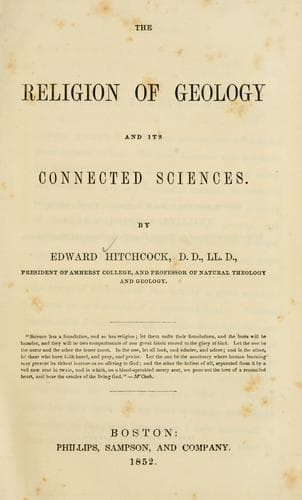
The Religion of Geology and Its Connected SciencesHitchcock, Edward
Religion
The Religion of Geology and Its Connected Sciences
Hitchcock, Edward
Bible and geology; Religion and science
In our attempts thus far to elucidate the religion of geology, our
attention has been directed to those points where this science has been
supposed to conflict with revelation; and I trust it has been made
manifest that the collision was rather with the interpretation than with
the meaning of Scripture; and that, in fact, geology, instead of coming
into collision with the Bible, affords us important aid in understanding
it aright. We now advance to a part of the subject which has a more direct
bearing upon natural religion. And here, if I mistake not, we shall find
the illustration of religious truth from this science, as we might expect,
more direct and palpable.
The subject to which I wish first to call your attention is the world's
eternity, or the eternal existence of matter. This was the universal
belief of the philosophers of antiquity, and, indeed, of most reasoning
minds where the Bible has not been known. The grand argument by which this
opinion was sustained is the well-known _ex nihilo nihil fit_, (nothing
produces nothing.) Hence men inferred that not even the Deity could create
matter out of nothing; and, therefore, it must be eternal. Most of the
ancient philosophers, however, did not hence infer the non-existence of
the Deity. But they endeavored to reconcile the existence of eternal
matter with an eternal Spirit. They supposed both to be self-existent and
coexistent. From this rational thinking principle they supposed all good
to be derived; while from the material irrational principle all evil
sprung. Plato taught that God, of his own will, united himself with
matter, although he did not create it, and out of it produced the present
world; so that it was proper to speak of the world as created, although
the matter was from eternity. Aristotle and Zeno taught that God's union
with matter was necessary; and hence they considered the world eternal. In
the opinion of Epicurus, God was entirely separated from matter, which
consisted of innumerable atoms, floating about from eternity, like dust in
the air, until at last they assumed the present form of the world.
In modern times, the belief in the eternity of matter has usually been
connected with, or made the basis of, a refined and popular system of
atheism. I refer to the pantheism of Spinoza. He maintains that there
exists in the universe but one substance, variously modified, whose two
principal attributes are infinite extension and infinite intelligence.
This substance, the [Greek: to pan] of Spinoza, he regarded as God; and
hence his system is called _Pantheism_. Under various modifications, it
has been adopted by many sceptical minds, and is, undoubtedly, the most
common and plausible system of atheism extant. Other modern writers, among
whom may be mentioned that anomalous philosopher Bayle, have advocated the
views of the ancients respecting the eternity of matter.
Public-domain text, read in full here on John Shaqi.
Reviews
Reviews
No reviews yet
Be the first to share your thoughts on this work.
Elsewhere in the archive
Join the Discussion
Join the discussion
Sign in to leave a comment or review.
Sign InorCreate an account