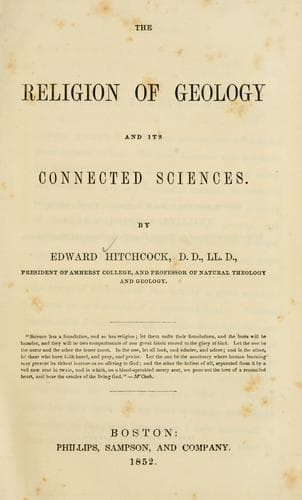
The Religion of Geology and Its Connected SciencesHitchcock, Edward
Religion
The Religion of Geology and Its Connected Sciences
Hitchcock, Edward
Bible and geology; Religion and science
It may seem strange, but it is true, that some Christian philosophers and
divines have been, in ancient and modern times, the advocates of the
eternity of matter. The ancient Christians adopted it from Plato. Thus we
find Justin Martyr maintaining that God formed the world from an eternal,
unorganized material. And the schoolmen, who followed Aristotle, taught
that "God had created the world from eternity." On this ground, even some
Protestant theologians have asserted that it was absurd to speak of an
eternal God who is not an eternal Creator.
A principle which has thus been adopted by so many acute minds
unenlightened by revelation, and by some who possessed that divine
testimony, must be sustained by some plausible arguments. The principal
one relied on is, that the changes which are going on in the material
world are proved to be only transmutations, which follow one another in
series that return into themselves, and which may, therefore, have been
going on from eternity; and if this be admitted, it is as easy to suppose
matter to be self-sustained, and to have fallen into its present order of
itself, as to suppose the interference of an infinite Spirit. "How do we
know," says Dr. Chalmers, in stating the atheistic argument, "that the
world is a consequent at all? Is there any greater absurdity in supposing
it to have existed, as it now is, at any specified point of time,
throughout the millions of ages that are past, than that it should so
exist at this moment? Does what we suppose might have been then, imply any
greater absurdity, than what we actually see to be at present? Now, might
not the same question be carried back to any point or period of duration,
however remote? or, in other words, might we not dispense with a beginning
for the world altogether?" "For aught we can know _a priori_," says Hume,
"matter may contain the source or spring of order originally within itself
as well as mind does; and there is no more difficulty in conceiving that
the several elements, from an internal, unknown cause, may fall into the
most exquisite arrangement, than to conceive that their ideas, in the
great universal mind, from a like internal cause, fall into that
arrangement. If this material world rests upon a similar ideal world,
this ideal world must rest upon some other, and so on without end. It
were better, therefore, never to look beyond the present material world.
By supposing it to contain the principle of its order within itself, we
really assert it to be God; and the sooner we arrive at that divine Being,
so much the better."
Public-domain text, read in full here on John Shaqi.
Reviews
Reviews
No reviews yet
Be the first to share your thoughts on this work.
Elsewhere in the archive
Join the Discussion
Join the discussion
Sign in to leave a comment or review.
Sign InorCreate an account