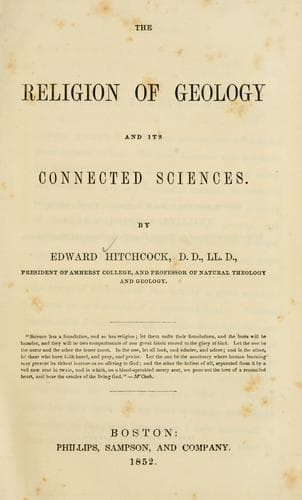
The Religion of Geology and Its Connected SciencesHitchcock, Edward
Religion
The Religion of Geology and Its Connected Sciences
Hitchcock, Edward
Bible and geology; Religion and science
"Whatever has existed from eternity, independent and without any external
cause, must be self-existent. Whatever is self-existent must exist
necessarily, by an absolute necessity in the nature of the thing. This is
also self-evident. It follows, therefore, that unless the material world
exist necessarily, by an absolute necessity in its own nature, so that it
must be a contradiction to suppose it not to exist, it cannot be
independent and eternal. In order to disprove this absolute necessity, he
[Dr. Clarke] reasoned thus: If matter be supposed to exist necessarily,
then in that necessary existence is included the power of gravitation, or
it is not. If not, then in a world merely material, and in which no
intelligent being presides, there never could have been any motion. But if
the power of gravitation be included in the pretended necessary existence
of matter, then it follows necessarily, that there must be a vacuum; it
follows, likewise, that matter is not a necessary being. For if a vacuum
actually be, then it is plainly more than possible for matter not to be."
Is it not passing strange that such a dreamy argumentation as this--and it
is a fair sample of Dr. Clarke's extended work on the existence of the
Deity--should have been regarded as sound logic by many of the acutest
minds, and that a majority even of the ablest metaphysicians, up almost
to the present day, should have felt satisfied with it? A few minds,
indeed, long ago perceived its fallacy, among whom was Alexander Pope, who
thus sarcastically describes it:--
"Be that my task, replies a gloomy Clarke,
Sworn foe to mystery, yet divinely dark.
Let others creep by timid steps and slow,
On plain experience lay foundation low,
By common sense to common notions bred,
And last to nature's cause through nature led,
All-seeing in thy mists, we need no guide,
Mother of arrogance, and source of pride!
We nobly take the high _priori_ road,
And reason downward till we doubt of God."
_Dunciad_, Book IV.
It is impossible, on this occasion, to go into a formal refutation of this
famous argument. But this is unnecessary; since, as Dr. Chalmers says, it
"has fallen into utter disesteem and desuetude." Indeed, the language of
Dr. Thomas Brown on this subject is not too severe, when he says, that he
"conceives the abstract arguments that have been adduced to show that it
is impossible for matter to have existed from eternity, by reasoning on
what has been termed necessary existence, and the incompatibility of this
necessary existence with the qualities of matter, to be relics of the mere
verbal logic of the schools, as little capable of producing conviction as
any of the wildest and most absurd of the technical scholastic reasonings
on the properties, or supposed properties, of entity and nonentity."
Public-domain text, read in full here on John Shaqi.
Reviews
Reviews
No reviews yet
Be the first to share your thoughts on this work.
Elsewhere in the archive
Join the Discussion
Join the discussion
Sign in to leave a comment or review.
Sign InorCreate an account