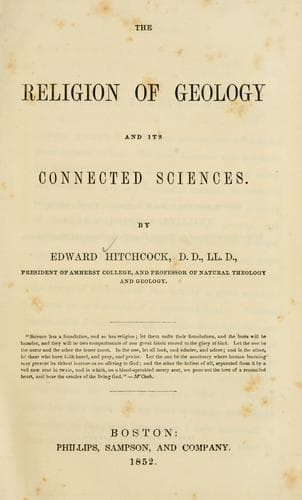
The Religion of Geology and Its Connected SciencesHitchcock, Edward
Religion
The Religion of Geology and Its Connected Sciences
Hitchcock, Edward
Bible and geology; Religion and science
In the second place, it has been argued with much apparent plausibility,
by Dr. Paley, that wherever we find a complicated organic structure,
adapted to produce beneficial results, its origin must be sought beyond
itself; and since the world abounds with such organisms, it cannot be
eternal; that is, the mere existence of animals and plants proves their
non-eternity.
Now, without asserting that there is no force in this argument, I have two
remarks to make upon it. The first is, to quote the reply to it, which
such a writer as David Hume has given, in language which I have just
repeated. "For aught we can know _a priori_," says he, "matter may
contain the source or spring of order originally within itself, as well as
mind does; and there is no more difficulty in conceiving that the several
elements, from an internal unknown cause, may fall into the most exquisite
arrangement, than to conceive that their ideas in the great universal
mind, from a like internal unknown cause, fall into that arrangement. To
say that the different ideas, which compose the reason of the Supreme,
fall into order of themselves, and by their own nature, is really to talk
without any precise meaning. If it has a meaning, I would fain know why it
is not as good sense to say, that the parts of the material world fall
into order of themselves and by their own nature. Can the one opinion be
intelligible while the other is not so?"
Fairly to meet this reasoning of the prince of sceptics is not an
achievement of dulness or ignorance. In order to do it triumphantly, we
want, what Dr. Paley could not find, a distinct example of the creation of
numerous organic beings by some cause independent of themselves. I say, he
could not find such an example; for on a question of natural theology, he
did not think it proper to appeal to the Bible; nor had geology, when he
wrote, revealed her astonishing record on this subject. But as it is now
developed, it puts an end to all controversy as to the origin of the
organic world.
My second remark, however, on this argument is, that even admitting its
correctness, it only proves the commencement of organic natures, but does
not show that the matter of which they are composed may not have been
eternal.
Public-domain text, read in full here on John Shaqi.
Reviews
Reviews
No reviews yet
Be the first to share your thoughts on this work.
Elsewhere in the archive
Join the Discussion
Join the discussion
Sign in to leave a comment or review.
Sign InorCreate an account