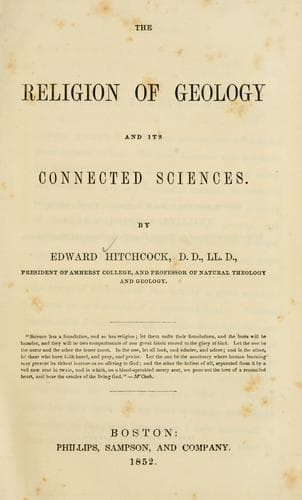
The Religion of Geology and Its Connected SciencesHitchcock, Edward
Religion
The Religion of Geology and Its Connected Sciences
Hitchcock, Edward
Bible and geology; Religion and science
In the third place, an argument against the eternal existence of matter
has been derived by Sir John Herschel, one of the most distinguished
natural philosophers of the day, from the atomic constitution of bodies,
as made known to us by chemistry. This science makes it certainly
probable, that even the infinitesimal particles of matter have a definite
and peculiar shape, and size, and weight, in each of the elements. "Now,"
says this writer, "when we see a great number of things precisely alike,
we do not believe this similarity to have originated, except from a common
principle independent of them." "The discoveries alluded to effectually
destroy the idea of an external self-existent matter, by giving to each of
its atoms the essential characters at once of a manufactured article and a
subordinate agent."
To this argument the atheist's reply would be essentially the same as that
last considered; and in one respect it would even be more forcible,
because the atomic constitution of bodies, being less complex, is less
obviously the result of foreign agency, and may more easily be regarded as
the necessary property of eternal matter. On the other hand, however, it
is more obviously an attribute of the original constitution of matter than
organic structure; and if it does require an independent agency for its
production, it seems difficult to conceive of the existence of matter in a
previous state. So that, in this point of view, this argument is more
forcible than the last; and it is no small evidence that it has real
strength, that it comes to us from one of the most acute and impartial
minds in Europe.
In the fourth place, it is maintained that the idea of an eternal
succession, or chain of being, which the atheistic advocates of the
world's eternity defend, is highly absurd, and even mathematically false.
The atheist mainly relies upon this notion of an eternal series of things;
for if he can defend that opinion, he will overturn the main argument of
the Theist for the divine existence, viz., that from design in the works
of creation. On this ground, therefore, he should be fairly met. Has he
been so met by the reasoning that has usually been employed to refute his
opinion? As a fair sample of it, I will here quote the leading points of
the argument, as given by one of the most popular and able theologians of
our country. "It is asserted by atheists," says Dr. Dwight, "that there
has been an eternal series of things. The absurdity of this assertion may
be shown in many ways."
"First. Each individual in a series is a unit. But every collection of
units, however great, is with intuitive certainty numerable, and,
therefore, cannot be infinite."
"Secondly. Every individual in the series (take for example a series of
men) had a beginning. But a collection of beings must, however long the
series, have had a beginning. This, likewise, is intuitively evident."
Public-domain text, read in full here on John Shaqi.
Reviews
Reviews
No reviews yet
Be the first to share your thoughts on this work.
Elsewhere in the archive
Join the Discussion
Join the discussion
Sign in to leave a comment or review.
Sign InorCreate an account