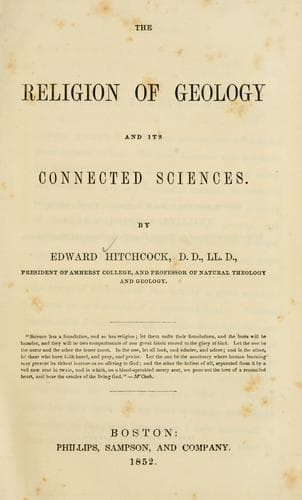
The Religion of Geology and Its Connected SciencesHitchcock, Edward
Religion
The Religion of Geology and Its Connected Sciences
Hitchcock, Edward
Bible and geology; Religion and science
These facts being admitted, and who does not see the necessity of divine
interference, whenever one race of animals and plants passed from the
earth in order to repeople it? It is not difficult to conceive how
volcanic fires, or aqueous inundations, may have carried universal
destruction over the globe, and bereft it of inhabitants. But where, save
in the fiat of an infinite Deity, is the power that can make this universe
of death teem again with life and beauty? In the powerful language of Dr.
Chalmers, we may inquire, "Is there aught in the rude and boisterous play
of a great physical catastrophe that can germinate those exquisite
structures, which, during our yet undisturbed economy, have been
transmitted in pacific succession to the present day? What is there in the
rush, and turbulence, and mighty clamor of such great elements, of ocean
heaved from its old resting-place, and lifting its billows above the Alps
and the Andes of a former continent,--what is there in this to charm into
being the embryo of an infant family, wherewith to stock and to repeople a
now desolate world? We see in the sweeping energy and uproar of this
elemental war enough to account for the disappearance of all the old
generations, but nothing that might cradle any new generations into
existence, so as to have effloresced on ocean's deserted bed the life and
loveliness which are now before our eyes. At no juncture, we apprehend, in
the history of the world, is the interposition of the Deity more manifest
than at this; nor can we better account for so goodly a creation emerging
again into new forms of animation and beauty from the wreck of the old
one, than that the spirit of God moved on the face of chaos, and that
nature, turned by the last catastrophe into a wilderness, was again
repeopled at the utterance of his word."
Sir Isaac Newton has said, that "the growth of new systems out of old
ones, without the mediation of a divine power, seems to me apparently
absurd." He seems in this passage to have referred only to the
arrangements of matter, "with respect to size, figure, proportions, and
properties," and not to the principle of life, of instinct, or of
intellect. But when the latter are taken into the account, it must be
superlatively absurd to suppose new systems can grow out of old ones by
merely natural operations. He, indeed, who can bring himself to believe,
with a certain writer, that "the instincts of animals are nothing more
than inert and passive attractions, derived from the power of sensation,
and the instinctive operations of animals nothing more than
crystallizations produced through the agency of that power,"--such a man
could probably easily persuade himself that, by the help of galvanism,
animals and plants might be the result of natural operations. Such
doctrines, however, we shall examine in another lecture.
Public-domain text, read in full here on John Shaqi.
Reviews
Reviews
No reviews yet
Be the first to share your thoughts on this work.
Elsewhere in the archive
Join the Discussion
Join the discussion
Sign in to leave a comment or review.
Sign InorCreate an account