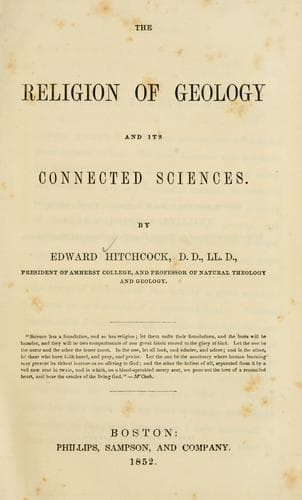
The Religion of Geology and Its Connected SciencesHitchcock, Edward
Religion
The Religion of Geology and Its Connected Sciences
Hitchcock, Edward
Bible and geology; Religion and science
My third example from geology, showing the non-eternity of the present
condition of the globe, is the fact of the disappearance of several large
species of animals since the commencement of the most recent or alluvial
geological period. Certain large pachydermatous and other animals, such as
the fossil elephant, the mastodon, the megatherium, the mylodon, the
megalonyx, the glyptodon, the fossil horse, ox, deer, &c., also nine or
ten species of huge birds--the dinornis, the palapteryx, aptornis,
notornis, and nestor of New Zealand, the dodo of Mauritius and Bourbon,
and the pezohaps or solitaire of Rodriguez,--have ceased to exist since
the tertiary period; some of them--the birds, for instance--since man's
creation. Now, if any important species of animals from time to time
disappear from any system of organic life, it shows a tendency to ruin in
that system; for such is the intimate dependence of different beings upon
one another, that you cannot blot out one, certainly not a large number,
without disturbing the healthy balance between the whole, and probably
bringing the whole to ultimate ruin. At any rate, if several species die
out by natural processes, no reason can be given why others should not, in
like manner, disappear. And to prove that any organic system shows a
tendency to ruin is to show that it had a beginning.
My third example from geology, demonstrating the special interference of
the Deity in the affairs of this world, is the fact of the comparatively
recent commencement of the human race. That man was among the very last of
the animals created is made certain by the fact that his remains are found
only in the highest part of alluvium. This is rarely more than one hundred
feet in thickness, while the other fossiliferous strata, lying beneath the
alluvium, are six miles thick.
Hence man was not in existence during all the period in which these six
miles of strata were in a course of deposition, and he has existed only
during the comparatively short period in which the one hundred feet of
alluvium have been formed; nay, during only a small part of the alluvial
period. His bones, having the same chemical composition as the bones of
other animals, are no more liable to decay; and, therefore, had he lived
and died in any of the periods preceding the alluvial, his bones must have
been mixed with those of other animals belonging to those periods. But
they are not thus found in a single well-authenticated instance, and,
therefore, his existence has been limited to the alluvial period. Hence he
must have been created and placed upon the globe--such is the testimony of
geology--during the latter part of the alluvial period.
Public-domain text, read in full here on John Shaqi.
Reviews
Reviews
No reviews yet
Be the first to share your thoughts on this work.
Elsewhere in the archive
Join the Discussion
Join the discussion
Sign in to leave a comment or review.
Sign InorCreate an account