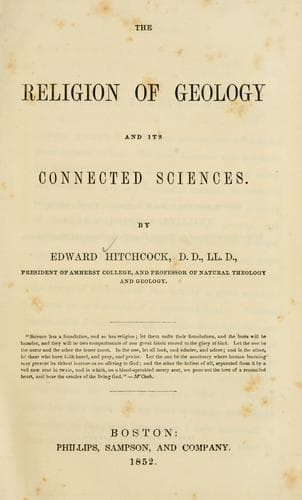
The Religion of Geology and Its Connected SciencesHitchcock, Edward
Religion
The Religion of Geology and Its Connected Sciences
Hitchcock, Edward
Bible and geology; Religion and science
I might include in this example nearly all the other species of existing
animals and plants, since it is only a very few of these that are found
fossil, and such species are limited to the tertiary strata. But since
this might make some confusion in the argument, and since man is
confessedly at the head of the existing creation, I prefer to let his case
stand out alone, and to regard it _instar omnium_.
Here, then, we have a case in which geology can lay her finger upon the
precise epoch, in the revolutions of our globe, in which the most
complicated, perfect, and exalted being that ever dwelt upon its surface
first began to be. It was not the commencement of a mere zoophyte, or
cryptogamean plant, in which we see but little superiority to unorganized
matter, except in their possession of a low degree of vitality. But we
have a being complicated enough to contain a million of parts, endowed
with the two great attributes of life, sensibility and contractility, in
the highest degree, and, above all, possessing intellect and moral powers
far more wonderful than organization and animal life.
As to the period when the creation of such a being, by the most
astonishing of all miracles, took place, I believe there is no diversity
of opinion. At least, all agree that it was very recent; nay, although
geology can rarely give chronological dates, but only a succession of
events, she is able to say, from the monuments she deciphers, that man
cannot have occupied the globe more than six thousand years.
Now, if it was difficult to conceive how successive races of the inferior
animals and plants could have originated in the laws of nature, without
the special interference of the Deity, that difficulty increases in a
rapid ratio as we ascend on the scale of organization and intellect, and
attempt in the same manner to account for the origin of man without the
miraculous agency of Deity. The thorough-going materialist, however, does
not shrink from the effort. "Thought," says Bory de St. Vincent, "being
the necessary result of a certain kind of organization, wherever this
order is established, thought is necessarily derived from it; and it is no
more possible for the molecules of matter, arranged in a certain manner,
not to produce thought, than for brass, when smitten, not to return a
sound, or for creatures formed by this matter, after such and such laws,
not to walk, not to breathe, not to reproduce; in a word, not to exercise
any of the faculties which result from their peculiar mechanism of
organization."--Dict. Clas. _D. Hist. Nat._ art. _Matiere_.
Public-domain text, read in full here on John Shaqi.
Reviews
Reviews
No reviews yet
Be the first to share your thoughts on this work.
Elsewhere in the archive
Join the Discussion
Join the discussion
Sign in to leave a comment or review.
Sign InorCreate an account