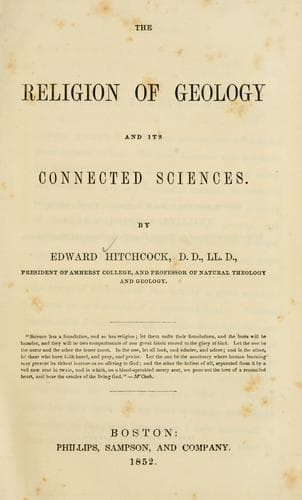
The Religion of Geology and Its Connected SciencesHitchcock, Edward
Religion
The Religion of Geology and Its Connected Sciences
Hitchcock, Edward
Bible and geology; Religion and science
Chemical analysis shows us that the mineral constituents of rocks are
essentially the same as those of soils; and that the latter differ from
the former, in a pulverized state, only in containing animal and vegetable
matter. Hence we cannot doubt but the soils originated from the rocks.
And, in fact, the process of their production is continually going on
under our eyes. Wherever the rocks are exposed to atmospheric agencies,
they are seen to crumble down; and, in fact, most of them, having been
long exposed, are now covered with a deposit of their own ruins, forming a
soil over them. This process is in part decomposition and in part
disintegration; and as we look upon rocks thus wasting away, we are apt to
be impressed with the idea that it is an instance of decay in nature's
works, which, instead of indicating benevolence, can hardly be reconciled
with divine wisdom. But when we learn that this is the principal mode in
which soils are produced, that without it vegetation could not be
sustained, and that a world like ours without plants must also be without
animals, this apparent ruin puts on the aspect of benevolence and wise
design.
_My second argument in proof of the divine benevolence is derived from the
disturbed, broken, and overturned condition of the earth's crust._
To the casual observer, the rocks have the appearance of being lifted up,
shattered, and overturned. But it is only the geologist who knows the vast
extent of this disturbance. He never finds crystalline, non-fossiliferous
rocks, which have not been more or less removed from their original
position; and usually he finds them to have been thrown up by some
powerful agency into almost every possible position. The older
fossiliferous strata exhibit almost equal evidence of the operation of a
powerful disturbing force, though sometimes found in their original
horizontal position. The newer rocks have experienced less of this
agency, though but few of them have not been elevated or dislocated.
Mountainous countries exhibit this action most strikingly. There it is
shown sometimes on a magnificent scale. Entire mountains in the Alps, for
instance, appear not only to have been lifted up from the ocean's depths,
but to have been actually thrown over, so as to bring the lowest and
oldest rocks at the top of the series. The extensive range of mountains in
this country, commencing in Canada, and embracing the Green Mountains of
Vermont, the Highlands of New York, and most of the Alleghany chain as far
as Alabama, a distance of some twelve hundred miles, has also been lifted
up, and some of the strata, by a lateral force, folded together, and then
thrown over, so as now to occupy an inverted position. Let us now see
wherein this agency exhibits benevolence.
Public-domain text, read in full here on John Shaqi.
Reviews
Reviews
No reviews yet
Be the first to share your thoughts on this work.
Elsewhere in the archive
Join the Discussion
Join the discussion
Sign in to leave a comment or review.
Sign InorCreate an account