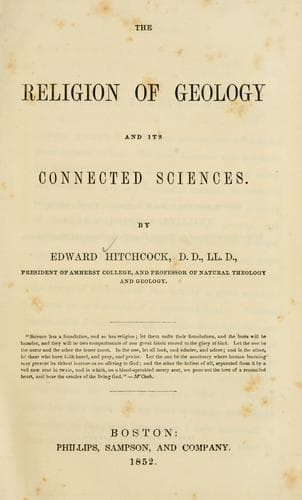
The Religion of Geology and Its Connected SciencesHitchcock, Edward
Religion
The Religion of Geology and Its Connected Sciences
Hitchcock, Edward
Bible and geology; Religion and science
If these strata had remained horizontal, as they were originally
deposited, it is obvious that all the valuable ores, minerals, and rocks,
which man could not have discovered by direct excavation, must have
remained forever unknown to him. Now, man has very seldom penetrated the
rocks below the depth of half a mile, and rarely so deep as that; whereas,
by the elevations, dislocations, and overturnings that have been
described, he obtains access to all deposits of useful substances that lie
within fifteen or twenty miles of the surface; and many are thus probably
brought to light from a greater depth. He is indebted, then, to this
disturbing agency for nearly all the useful metals, coal, rock salt,
marble, gypsum, and other useful minerals; and when we consider how
necessary these substances are to civilized society, who will doubt that
it was a striking act of benevolence which thus introduced disturbance,
dislocation, and apparent ruin into the earth's crust?
Another decided advantage resulting from this disturbing agency is the
formation of valleys.
If we suppose the strata spread uniformly over the earth's entire surface,
then the ocean must envelop the whole globe. But, admitting such
interruptions in the strata to exist as would leave cavities, where the
waters might be gathered together into one place, and the dry land appear,
still that dry land must form only an unbroken level. Streams of water
could not exist on such a continent, because they depend upon inequalities
of surface; and whatever water existed must have formed only stagnant
ponds, and the morasses which would be the consequence would load the air
with miasms fatal to life; so that we may safely pronounce the world
uninhabitable by natures adapted to the present earth. But such,
essentially, must have been the state of things, had not internal forces
elevated and fractured the earth's crust. For that was the origin of most
of our valleys--of all the larger valleys, indeed, which checker the
surface of primary countries. Most of them have been modified by
subsequent agencies; but their leading features, their outlines, have been
the result of those internal disturbances which spread desolation over the
surface. We are apt to look upon such an agency as an exhibition of
retributive justice, rather than of benevolence. And yet that admirable
system for the circulation of water, whereby the rain that falls upon the
surface is conveyed to the ocean, whence it is returned by evaporation,
depends upon it. It imparts, to all organic nature, life, health, and
activity; and had it not thus ridged up the surface, stagnation and death
must have reigned over all the earth. In the unhealthiness of low, flat
countries, at present, we see the terrible condition of things in a world
without valleys. Can we doubt, then, that it was the hand of benevolence
that drove the ploughshare of ruin through the earth's crust, and ridged
up its surface into a thousand fantastic forms?
Public-domain text, read in full here on John Shaqi.
Reviews
Reviews
No reviews yet
Be the first to share your thoughts on this work.
Elsewhere in the archive
Join the Discussion
Join the discussion
Sign in to leave a comment or review.
Sign InorCreate an account