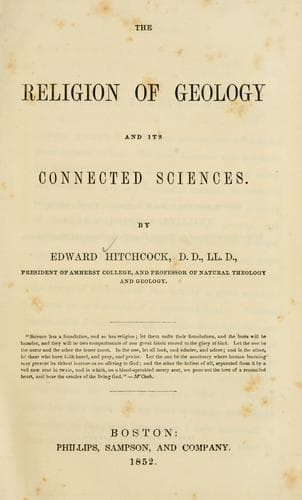
The Religion of Geology and Its Connected SciencesHitchcock, Edward
Religion
The Religion of Geology and Its Connected Sciences
Hitchcock, Edward
Bible and geology; Religion and science
the dead. Hundreds had crowded upon a new quay surrounded by vessels. In a
moment the earth opened beneath them, and the wharf, the vessels, and the
crowd went down into its bosom; the gulf closed, the sea rolled over the
spot, and no vestige of wharf, vessels, or man ever floated to the
surface. How thrilling is the account left us by Kircher, who was near, of
the destruction of Euphemia, in Calabria, a city of about five thousand
inhabitants, in the year 1638! "After some time," says he, "the violent
paroxysm of the earthquake ceasing, I stood up, and, turning my eyes to
look for Euphemia, saw only a frightful black cloud. We waited till it had
passed away, when nothing but a dismal and putrid lake was to be seen
where the city once stood." In like manner did Port Royal, in the West
Indies, sink beneath the waters, with nearly all its inhabitants, in less
than one minute, in the year 1692.
Still more awful, though usually less destructive, is often the scene
presented by a volcanic eruption. Imagine yourselves, for instance, upon
one of the wide, elevated plains of Mexico, far from the fear of
volcanoes. The earth begins to quake under your feet, and the most
alarming subterranean noises admonish you of a mighty power within the
earth that must soon have vent. You flee to the surrounding mountains in
time to look back and see ten square miles of the plain swell up, like a
bladder, to the height of five hundred feet, while numerous smaller cones
rise from the surface still higher, and emit smoke; and in their midst,
six mountains are thrown up to the height, some of them at least, of
sixteen hundred feet, and pour forth melted lava, turning rivers out of
their course, and spreading terrific desolation over a late fertile plain,
and forever excluding its former inhabitants. Such was the eruption, by
which Jorullo, in Mexico, was suddenly thrown up, in 1759.
Still more terrific have been some of the eruptions in Iceland. In 1783,
earthquakes of tremendous power shook the whole island, and flames burst
forth from the ocean. In June these ceased, and Skaptar Jokul opened its
mouth; nor did it close till it had poured forth two streams of lava, one
sixty miles long, twelve miles broad, and the other forty miles long, and
seven broad, and both with an average thickness of one hundred feet.
During that summer the inhabitants saw the sun no more, and all Europe was
covered with a haze.
Around the Papandayang, one of the loftiest mountains in Java, no less
than forty villages were reposing in peace. But in August, 1772, a
remarkable luminous cloud enveloping its top aroused them from their
security. But it was too late. For at once the mountain began to sink into
the earth, and soon it had disappeared with the forty villages, and most
of the inhabitants, over a space fifteen miles long and six broad.
Public-domain text, read in full here on John Shaqi.
Reviews
Reviews
No reviews yet
Be the first to share your thoughts on this work.
Elsewhere in the archive
Join the Discussion
Join the discussion
Sign in to leave a comment or review.
Sign InorCreate an account