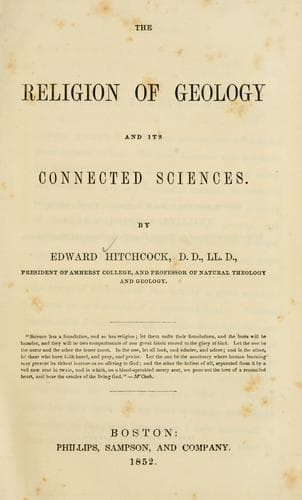
The Religion of Geology and Its Connected SciencesHitchcock, Edward
Religion
The Religion of Geology and Its Connected Sciences
Hitchcock, Edward
Bible and geology; Religion and science
Still more extraordinary--the most remarkable on record--was an eruption
in Sumbawa, one of the Molucca Islands, in 1815. It began on the fifth day
of April, and did not cease till July. The explosions were heard in one
direction nine hundred and seventy miles, and in another seven hundred and
twenty miles. So heavy was the fall of ashes at the distance of forty
miles that houses were crushed and destroyed. The floating cinders in the
ocean, hundreds of miles distant, were two feet thick, and vessels were
forced through them with difficulty. The darkness in Java, three hundred
miles distant, was deeper than the blackest night; and finally, out of the
twelve thousand inhabitants of the island, only twenty-six survived the
catastrophe.
Now, if we confine our views to such facts as these, we can hardly avoid
the conclusion that earthquakes and volcanoes are terrific exhibitions of
God's displeasure towards a fallen and guilty world. But if it can be
shown that the volcanic agency exerts a salutary influence in preserving
the globe from ruin, nay, is essential to such preservation, we must
regard its incidental destruction of property and life as no evidence of a
vindictive infliction, nor of the want of benevolence in its operation.
And the remarkable proofs which modern geology has presented of vast
accumulations of heated and melted matter beneath the earth's crust, do
make such an agent as volcanoes essential to the preservation of the
globe. In order to make out this position, I shall not contend that all
the earth's interior, beneath fifty or one hundred miles, is in a state of
fusion. For even the most able and decided of those geologists who object
to such an inference, admit that oceans of melted matter do exist beneath
the surface. And if so, how liable would vast accumulations of heat be, if
there were no safety-valves through the crust, to rend asunder even a
whole continent? Volcanoes are those safety-valves, and more than two
hundred of them are scattered over the earth's surface, forming vent-holes
into the heated interior. Most of them, indeed, have the valves loaded,
and the effort of the confined gases and vapors to lift the load produces
the terrific phenomena of earthquakes and volcanoes. But if no such
passages into the interior existed, what could prevent the pent-up gases
from accumulating till they had gained strength enough to rend a whole
continent, and perhaps the whole globe, into fragments? Is it not, then,
benevolence by which this agency prevents so dreadful a catastrophe, even
by means that bring some incidental evils along with them?
Public-domain text, read in full here on John Shaqi.
Reviews
Reviews
No reviews yet
Be the first to share your thoughts on this work.
Elsewhere in the archive
Join the Discussion
Join the discussion
Sign in to leave a comment or review.
Sign InorCreate an account