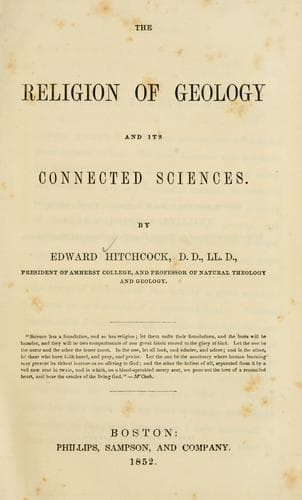
The Religion of Geology and Its Connected SciencesHitchcock, Edward
Religion
The Religion of Geology and Its Connected Sciences
Hitchcock, Edward
Bible and geology; Religion and science
Now, geology furnishes us with many examples, in which
agencies, often fraught with terrific evils, are nevertheless eminently
beneficial when the whole extent of their operation is taken into account.
Why is it not a fair inference that, in all other cases where evils stand
out prominently, they are only incidental results of some wide system of
operations, of which our limited vision embraces only a part, but whose
tendencies as a whole are eminently salutary, and whose incidental evils
do, in fact, increase the salutary effects? If so, what reason have we to
believe that, when the light of eternity shall clarify our mental eye, and
enlarge our knowledge of the present system of the universe, we shall find
all "partial evil to be universal good," and that our narrow views alone
threw obscurity and difficulty over this subject in this life? O, if even
here so many rays of divine love find their way into our narrow
prison-house, what will be their brightness when they pour in upon us from
the unveiled glories of the heavenly world!
LECTURE VII.
DIVINE BENEVOLENCE AS EXHIBITED IN A FALLEN WORLD.
The geological proofs of the divine benevolence considered in the last
lecture present only a partial view of that glorious characteristic of
Jehovah. I am tempted, therefore, to exhibit it in its more general aspect
and broader relations. This will necessarily bring into view other
important religious truths respecting man's fallen condition and
character, and, as a consequence, the modified aspect of the divine
goodness in such a world.
To those destitute of a revelation this world has, indeed, ever seemed an
inextricable maze, an enigma too dark for human wisdom to solve. Nor have
those favored with the Bible agreed in their modes of clearing up the
mystery. Having endeavored to explain all by following out some leading
and favorite idea, their theories have varied as these predominant
conceptions differed. One, for instance, fixes his gaze so intently upon
the divine benevolence that he is blind to every manifestation of
Jehovah's sterner attributes. Another, deeply impressed with the story of
man's original apostasy, sees only vindictive justice, and penal
infliction, and disordered action, in all the movements of nature and the
trials and sufferings of man. A third, captivated by the discoveries of
modern geology, relative to the existence of suffering and death in the
world before man's creation, and learning, moreover, from physiology,
that death is a general law of all organized natures, vegetable as well as
animal, is led to doubt whether the disorders of the world have any
important connection with man's apostasy.
Now, it were easy to show that our views on these subjects have a most
important bearing upon our entire system of theology; and, therefore, they
deserve our most thorough and candid examination. To such an examination I
now invite your serious attention.
Public-domain text, read in full here on John Shaqi.
Reviews
Reviews
No reviews yet
Be the first to share your thoughts on this work.
Elsewhere in the archive
Join the Discussion
Join the discussion
Sign in to leave a comment or review.
Sign InorCreate an account