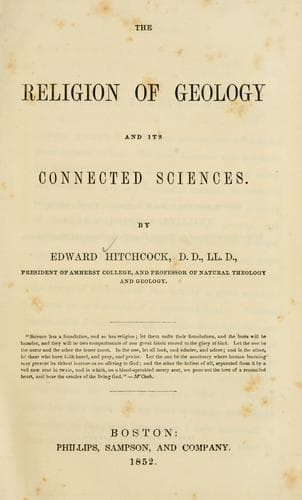
The Religion of Geology and Its Connected SciencesHitchcock, Edward
Religion
The Religion of Geology and Its Connected Sciences
Hitchcock, Edward
Bible and geology; Religion and science
It is not my object to appeal to the Scriptures to prove the divine
benevolence. That were an easy task. So, were this an unfallen world,
every object and event would be redolent of God's goodness. But where sin
and death abound, that goodness must assume a different aspect, since its
unmixed manifestation would work mischief. Now, the point aimed at in this
lecture is to ascertain whether natural religion can point out decisive
evidence of divine benevolence. We can conceive it quite possible that in
a fallen world God might find it necessary so to mingle displays of
justice with those of goodness, that man might be in doubt which
predominated.
There is another reason for considering this subject apart from scriptural
evidence. We need to establish the doctrine of divine benevolence as a
basis on which to rest the evidences of inspiration; or, rather, we want
to be able to assume God's benevolence, in arguing for the truth of the
Bible, and in judging of its contents. This doctrine, therefore, is one of
the most important, as it is certainly the most difficult, in natural
theology.
Obviously the first step in this investigation must be to ascertain what
is the real state of this world, as a manifestation of the benevolence and
justice of God. In other words, we need to ascertain what exhibitions of
these attributes are presented to us in nature, and in the economy of
Providence, and how much of the evil in the world is to be imputed to
man's perversion of the gifts of God. I shall proceed, therefore, to state
the main points on this subject which fair and candid reasoning seems to
me to sustain. When these points are before us, with a summary of the
evidence by which they are supported, we shall be prepared to deduce
important conclusions respecting God's character and dispensations, and
man's position and destiny.
_In the first place, then, I maintain that benevolence decidedly
predominates in the present system of the world._
Let this proposition be fully understood. It does not mean that there is
no mixture of evil in the operations of nature, but only that good
decidedly overbalances the evil. And by the operations of nature I mean
those processes resulting from natural laws, which are uninfluenced by the
perverseness of man. How much of evil may be imputed to his perversion of
the gifts of Providence will be considered in another place, as will also
those cases in which evil seems inseparable from the original arrangements
of the world. All that I am now concerned to prove is, that, in a vast
majority of instances, we see the marks of benevolent design and
benevolent operation in the arrangements of nature.
This position is established, in the first place, by the fact that the
design of every natural contrivance is to produce happiness.
Public-domain text, read in full here on John Shaqi.
Reviews
Reviews
No reviews yet
Be the first to share your thoughts on this work.
Elsewhere in the archive
Join the Discussion
Join the discussion
Sign in to leave a comment or review.
Sign InorCreate an account