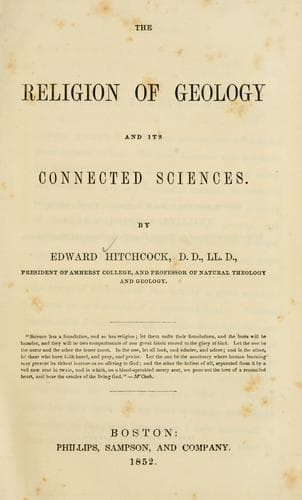
The Religion of Geology and Its Connected SciencesHitchcock, Edward
Religion
The Religion of Geology and Its Connected Sciences
Hitchcock, Edward
Bible and geology; Religion and science
In the process of deglutition, or swallowing the nourishment essential to
the existence of all the more perfect animals,--since the food and the air
for respiration pass for a time through a common opening, the pharynx,--it
is extremely important that the passage to the lungs should be most
vigilantly guarded; since strangulation would follow the introduction
there of any thing but air. Accordingly, the entrance of the glottis is so
sensitive, that the approach of the food causes it to close. But lest this
security should sometimes fail, we have an additional guard in the
epiglottis, which shuts down like a valve upon the orifice. Even with this
double precaution, strangulation sometimes follows the act of deglutition.
How much oftener would it occur, had not benevolence thus multiplied its
vigilant sentinels at the point of danger!
Another illustration of this argument lies in the fact, that many of the
organs of animals and plants possess the power, when an exigency requires
it, of greatly increasing their action. When, for instance, an unusual
quantity of osseous matter is requisite to repair a broken bone, the
glands, whose office it is to elaborate that matter, are capable of
secreting an extraordinary quantity, until the injury is repaired.
Of an analogous character is the sympathy existing between the different
organs, so that when one has an unusual amount of labor to perform, the
rest impart of their nervous energy to sustain their overtasked companion.
Thus, and thus only, could animals be carried through many of the severe
exigencies of their existence. Their organs help one another, just as if
they were conscious of one another's necessities, and were prompted by
benevolence to aid the weakest.
In like manner, some of the organs possess the power of vicarious
secretion; that is, of producing, in peculiar circumstances, secretions
that are usually made by other glands. How they can do this, and how they
can know when to do it, are among the mysteries of physiology.
Nevertheless, the object of this arrangement is most obvious, viz., the
continuance of health and life in spite of accidents, which would
otherwise prove fatal.
The same vicarious system is manifest in the well-known examples, where
the loss of one or more of the senses gives increased acuteness to the
rest. The sense of touch, for instance, in the blind man, has sometimes
proved no mean substitute for eyes; and, indeed, any of the senses by
cultivation, in peculiar exigencies, may be prodigiously strengthened.
Public-domain text, read in full here on John Shaqi.
Reviews
Reviews
No reviews yet
Be the first to share your thoughts on this work.
Elsewhere in the archive
Join the Discussion
Join the discussion
Sign in to leave a comment or review.
Sign InorCreate an account