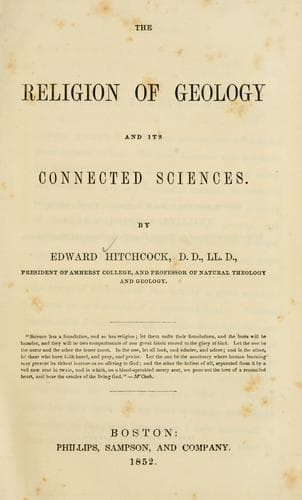
The Religion of Geology and Its Connected SciencesHitchcock, Edward
Religion
The Religion of Geology and Its Connected Sciences
Hitchcock, Edward
Bible and geology; Religion and science
might have been hateful in the extreme.
Had such a state of things existed, how very clearly we should have
inferred the malevolence of the Author of nature! Or if such a state had
been witnessed about as often as its opposite, we might reasonably have
said that he was indifferent to the happiness of his creatures. Why, then,
may we not, with equal reason, infer his benevolence, when we find, in a
vast majority of cases,--nay, for aught I know, universally,--that
pleasure is superadded to animal enjoyment where it was wholly unnecessary
to the perfect operation of nature's laws?
The fact is, God has made all nature "beauty to our eye and music to our
ear," when it was wholly unnecessary for the perfect operation of her
laws; and the inference is irresistible, that he delights in the happiness
of his creatures. Nor can the fact that evil exists in the world destroy
the force of this argument, unless that evil is so general as to be
obviously the design of the Creator in devising and arranging the system
of the world. While we admit its existence, we say that it is only
incidental, and that pleasure is so often superadded unnecessarily, as to
prove happiness to be the design, and evil the exception.
The two arguments above presented are the evidence on which Dr. Paley
relies to prove the divine benevolence. They are, indeed, as it seems to
me, unanswerable. But if I mistake not, they do by no means exhaust the
storehouse of nature's proofs of this fundamental principle of natural
and revealed religion. I derive a third argument for the predominance of
benevolence in the works of nature from the variety of means often
provided for the performance of important functions; so that animals and
plants can adapt themselves to different circumstances, and prolong their
existence.
The examples which I have in mind to illustrate this argument are all
derived from the organic world. I refer, for instance, to the fact that
nearly all our muscles, and many other important organs, as the hands, the
feet, the eyes, and the lungs, are in pairs, so that if one meets with an
injury, or is destroyed, the other can, to some extent, perform the office
of both. The brain has two hemispheres, and one of them may be seriously
wounded without destroying the healthy action of the other.
But perhaps the most appropriate example is in the blood-vessels, whose
inosculations are so numerous that even though large arteries and veins be
tied, the blood will find its way through the smaller ones, which
ultimately will so enlarge as to keep up the circulation nearly as well as
before the injury. And, in fact, almost every one of the large
blood-vessels has been tied by the surgeon with little ultimate injury to
the patient.
Public-domain text, read in full here on John Shaqi.
Reviews
Reviews
No reviews yet
Be the first to share your thoughts on this work.
Elsewhere in the archive
Join the Discussion
Join the discussion
Sign in to leave a comment or review.
Sign InorCreate an account