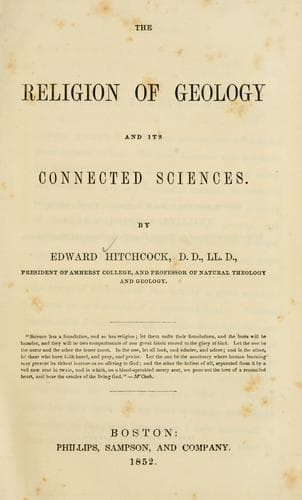
The Religion of Geology and Its Connected SciencesHitchcock, Edward
Religion
The Religion of Geology and Its Connected Sciences
Hitchcock, Edward
Bible and geology; Religion and science
Now, if this power were not possessed in such a world as ours, could
organic natures not bend at all to circumstances, constant suffering and
premature dissolution would be the result. The power of adaptation,
therefore, looks like the benevolent provision of a kind Father, who
wishes to make his creatures as happy as he can in the circumstances in
which his wisdom has placed them. Certainly, malevolence, or indifference
to their happiness, would not have introduced this power of adaptation
into their natures; for it is certain that their continued existence might
have been secured in some other way, had no reference been had to their
happiness.
I base my fourth argument for the predominance of benevolence, in the
arrangements of nature, upon the aggregate results of the most destructive
and terrific agencies which she employs.
The immediate effects of these agencies are often so appalling and so
unmixed with good, that men view them only as penal inflictions; or, when
the sufferers are unconscious of guilt, as mysterious dispensations of
evil, which need the light of another world to reconcile with infinite
benevolence. When the tornado or sirocco's hot breath sweeps over the
devoted land; when the river overflows its banks, and ingulfs the
defenceless inhabitants along its course, or the giant waves of the ocean
roll in upon the devoted shore; when the heaving earthquake overturns in a
moment vast cities, and the earth swallows them in its bosom; or when the
volcano pours out its suffocating smoke and its scorching lava, and
obliterates from earth the defenceless town, as once Herculaneum and
Pompeii were converted into petrified cities,--in the midst of such
desolating agencies, where can we discover a gleam of benevolence? Not
surely in the immediate effects. But suppose the tornado, the flood, the
earthquake, and the volcano are essential to the preservation of the earth
from a far wider ruin, so that, in fact, while they destroy some property
and life, they preserve a far greater amount, and are essential to such
preservation,--why is it not benevolence that gives a slight play to these
terrific elements, while it checks their wild war so soon as the requisite
security has been obtained? When the storm has sufficiently purified the
atmosphere, when the flood has enriched the wide alluvial fields, and the
earthquake and the volcano have given vent to the pent-up fires in the
earth, so that they no longer threaten to rend a continent asunder, then a
restraining power is put upon them, and they are allowed no more range
than is essential to the general good. We may not, indeed, see why the
good could not be secured without the evil. But this question leads to the
inquiry, whether the present system of the universe is the best possible;
and that it is so we have the guaranty of the divine perfections. Those
perfections admit the existence of evil; but at the same time they take
Public-domain text, read in full here on John Shaqi.
Reviews
Reviews
No reviews yet
Be the first to share your thoughts on this work.
Elsewhere in the archive
Join the Discussion
Join the discussion
Sign in to leave a comment or review.
Sign InorCreate an account