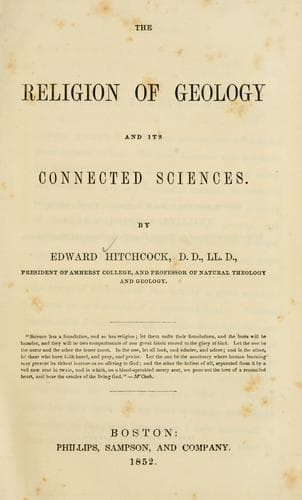
The Religion of Geology and Its Connected SciencesHitchcock, Edward
Religion
The Religion of Geology and Its Connected Sciences
Hitchcock, Edward
Bible and geology; Religion and science
care that the aggregate result of the greatest evils should be beneficial.
Nor would we limit this position to evils springing out of the nature or
the changes of the inanimate world; for some of the severest evils are
dependent upon the organization or operation of animate nature. Man, for
instance, finds himself often grossly annoyed by some species of the
inferior animals, in his comfort, property, and even life. And he wonders
why infinite wisdom and benevolence should permit certain species to
exist, when they seem fitted only to annoy the rest. But he knows not what
he desires when he wishes their extinction. For such is the balance of
organic nature, that to strike out even one species, is like removing a
link from a chain. Once broken, every other link is affected, and the
whole chain lies useless upon the ground. Or, to speak without a figure,
if you blot out certain species of animals or plants, you disturb the
balance of the whole system of organic nature; nor can you tell where the
disturbance thus introduced will end. It may lead to the excessive
multiplication of species still more injurious than those you have
destroyed. At any rate, since the perfections of the Deity lead to the
conclusion that the existing proportion between different species is the
best, all things considered, and change in the balance must be injurious,
we may conclude, that though noxious animals and plants may produce
individual inconvenience and injury, the aggregate effects upon the whole
of organic nature are salutary, and, therefore, indicative of benevolence.
Similar reasoning will, I think, apply to the existence of that large
class of animals called carnivorous. These are evidently intended to prey
upon other animals; and for this purpose they are provided with weapons
for seizing and destroying their prey. It is often extremely painful to a
man of kind feelings to witness the scenes of blood and havoc which these
flesh-eating animals produce. But we forget two things. The first is, that
in order to keep the numbers of animated beings full in the different
tribes, it is necessary that there should be a great excess of numbers
created, to meet all the casualties to which they are exposed; and that
excess must in some way or other be removed from life. Secondly, all the
enjoyment of the carnivorous races is so much clear gain to the sum of
animal happiness; for the excess of numbers in the tribes of vegetable
feeders suffer no more in being destroyed by the carnivorous races, than
if they died in some other way; not so much, indeed, as if they perished
by famine. We may safely conclude, then, that even this system of mutual
slaughter, when viewed in all its relations, is the means, in such a world
as ours, of increasing the amount of enjoyment, and is, therefore, a
benevolent provision.
Public-domain text, read in full here on John Shaqi.
Reviews
Reviews
No reviews yet
Be the first to share your thoughts on this work.
Elsewhere in the archive
Join the Discussion
Join the discussion
Sign in to leave a comment or review.
Sign InorCreate an account